I’ve walked these streets before, decades ago. We’d drive the six hundred miles south for Christmas, for funerals, for two weeks every summer while Dad served his time in Army Reserves. What I remember of the streets isn’t much — the panaderia with the best cochinitos, the two story building pockmarked by time where Papa Romulo ran his tailor shop & his cantina, the shops we never entered, the shops that used to be. With every walk down those dusty hot sidewalks, I wanted to get back to the house of my mother’s childhood, back to the pomegranate tree & the screen door with the bell, back to our BB gun and the mesquite trees with their undulating thick branches shading the packed dirt. I haven’t been down those Rio Grande streets in decades.
As I’ve said elsewhere, there’s little there for me now but dusty graves & deep memories. My mother’s childhood home, the only home I knew there, has bougainvillea where the salt cedar once soared, tin foil on the front windows. My brother Raul has the aluminum lawn chairs from the back yard, chairs sunbaked over time from candy-apple red to rust. The display cabinets from Mama Tulitas’s store are in my parents’ garage, once stocked with fresh bread, now packed with gardening equipment & hundred-year-old hat blocks. Not everything is lost.
Recently, I zoomed in on these Rio Grande City streets — or to be more precise, on an alley where my great grandfather Papa Pedro worked as a blacksmith. Click by click, I walked those streets, found that alley, advancing by digital leaps, the camera of all things on a tab nestled between a recipe for Dijonnaise grilled chicken breasts & student submissions waiting to be graded, the camera lens advancing fifty feet at a time in pixelated bursts, landing on sharp focus high-def ground. Getting closer & closer to the terrain if not the hour of this time of hard labor, of honest labor, of manhood, of Mexicanness I never knew. A daydreamer at heart, I don’t need much to conjure up a living laughing version of the strong, serious, mustached man in the photo (one of two we have of him). The digital search / journey awakened nothing my mother hadn’t already shared decades before with the five of us kids walking through the Valley heat, interrupted by her childhood friends running errands. We rolled our eyes. They ignored our boredom, relishing the blessing, the surprise, the luxury platicando. A pin was always in a map somewhere. Now I had seen it.
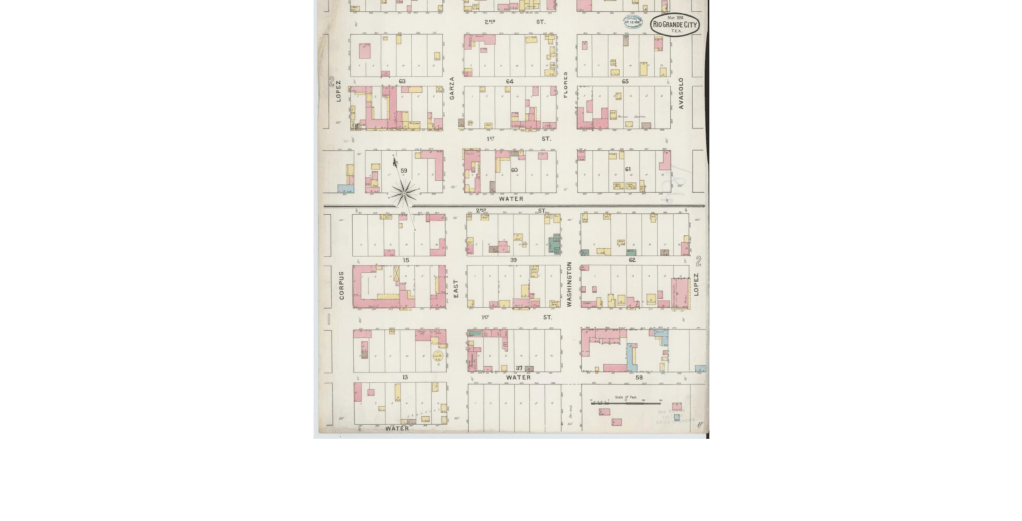
I went looking for it again in the Library of Congress and found a Sanborn Fire Insurance map of Rio Grande City from May 1894 (one of two the LOC hosts). Even back then, the town had a meticulous geometric order. Sanborn marks the equidistant east-west water lines running beneath a land where water means citizenship, where water means life, where water is a commodity almost as valuable to find as natural gas. Each lot in nearly equal proportions with its neighbors, each street in rectilinear dignity with / apart from the others. From this gods-eye view, Sanborn commemorates each owner shaping the stuff of creation, innovating & compromising within the perimeter of their respective lots, making this little postage stamp of a world their own.
Some homes built as far from the “traffic” as possible. Some buildings (businesses, clearly) constructed as close to the street as safety & city codes will allow. Sanborn color-coded the maps, a different color for each material. Tile. Stone. Wood frame. Brick. Sanborn Fire Insurance imagined a plan for one particular kind of disaster, the kind of disaster that struck one mile west of where the blacksmith shop once stood, that struck my mother’s childhood home on Fairgrounds Road at the Rio Grande City home I knew, that struck July 2, 1981, my twelfth birthday. I had spent that night fifteen miles away at my paternal grandparents’ house in Roma. My great grandfather was long dead. I don’t know where the water lines were in 1981, but I see now where they were in 1894. The time of Sanborn’s map was a time of caution, of preparedness, a time of knives & saws, of clothes lines & woodstoves, of hand carved existences.
My great grandfather had strong rough hands moving quickly in the heat, moving briskly from fire to anvil. He bent iron. It was right there, just outside the frame of the map.
 middleagedmiddlechild.