His hat & his belt,
his stance & his stare
all announce the gravity
of this moment at the plate.

He'll finally get to run --
a rarity in this game.

I lean against the chain links
with the other dads,
letting them chatter,
knowing that he knows
I am there, watching
behind the hot cage of boys.

He steps to the plate,
plants and grinds his cleats
in the white striped box.
I feel something pool
deep in my stomach, worry
that he'll miss, or worse,
that he'll be thrown out at first.
But he sees the pitch’s arc
and he knows. He knows.

A ping of aluminum,
and a flash over
the dad who's pitching.

I gasp at my boy,
delight in his hopeful speed.


This one is years old. I've written about this subject, this child before : )
We stopped at the farm
because Mari wanted to see
her grandparents.

The highway turned
to farm road
to cracked blacktop
to gravel winding
between rows
I couldn't identify.

A straw hat moved
among the rows, stopped.
A shot ran out. I jumped
in the back seat.

"Grandpa must've found a snake."

I walked with Mari
to the house, comically citified
in vintage store Dickies & Vans.
Grandpa shook my hand,
a child's hand in his rough, raw
shotgun hands.

We drank chicory coffee,
eating a storebought lemon cake.

"Come see the peaches."

Grandpa plucked one
hanging deep in the boughs.
We ate beneath the trees
heavy with fruit,
sequined by the sun.
Ours is a campus distracting,
downright manic in its care. Counselors,
specialists & advisors lining
its expensive halls. Every student an honors
student. So the manicured
lawns & catalogued trees fit.
One tree so young no bird
could find room to nest in it.
One tree in a line of dozens
not yet tagged but firmly roped
to the ground, a blue ribbon
low on its wrist-thick trunk. Hope
springs eternal for small things.
Listen for its wind-tousled rustlings.
I have a better understanding now of love
          but not of loss.
I have children & a wife, happy & healthy,
          none of whom has suffered
anything uncommon to middle class bubbles.
          No cars have been mangled,
the seats & buckles haven't failed, and AAA arrives
          in the rare moments we need help.
Teachers love my children & share good news.
          No detentions or reports burden us.

It has often been this way, this flow of joys
          interrupted with the rare heartbreak.
Music & books, clouds & birdsong sustained me
          while my wife worked hard into the night,
Friends & concerts, nights laughing in parks
          while my parents struggled & sacrificed for me.
Grad school prolonged an untested belief in beauty
          when others suffered & lost (& even died).

          Perhaps now I'm fueling a reserve
of good will, good health, & good fortune
          to draw upon in some hospital years from now.
Experts, harried, will explain the diagnosis,
          my family will adjust their schedules,
will delay long-hoped-for plans, will lose sleep,
          caring for the frail me I can only imagine.
May I have the strength to find the joy then
          that I take for granted now. May my family
feel that the end of a good life need not be a loss at all.


This was originally just the first & the last stanzas. Adding the middle one made it a kind of sonnet, in my mind.
My first grade teacher was a tall
kind-hearted joyful woman.
Her hair was perfect, symmetrical
waves of the brightest red
framing her clean forehead,
blooming from the front of her veil.
We were told
that her hair went far
down her back.
I never saw it.
My mother did.

I loved that teacher with
something about as pure as
how she loved me, about as pure
as how she loved Jesus. I loved
her so much that I was jealous
of how she loved other kids,
of how sometimes my mom
talked to her and had business
with her that didn't include me.

There's a photo of a bicentennial cake
taking up her entire classroom:
Donated refrigerator boxes covered
with construction paper, toilet paper
tubes fashioned into two hundred
birthday candles.  And another photo
of our First Communion, innocent
children lined up by height, led by her
to the altar, identical Amens
synchronized and choreographed
to purity and perfection.

And picture day, a rare day
out of our uniforms. I had a new shirt
with Mexican embroidery on the pockets.
At the front of the line, she stood,
dabbing Vaseline on each student's lips.
She put her hands on my shoulders and told me
I was handsome.  "Smile, honey."

Her name was Sister Rosaline. That entire year she taught me first grade, she also served as a prison chaplain, as she did for years after. After she retired from teaching, she served in hospital ministry until her death in 2007.
Some sparks are effortless. Some remind you that sparks fly only when there’s friction, collisions between strong materials.
Because it was a Texas college town in the 90s, there were cigarettes. She smoked a lot. He was surprised if he saw her not smoking. She had the reputation of holding her own. He only knew guys that talked as much as she did, but not usually in dialogue. His friends would hold forth on a band or on a movie, and the fun was sitting back and seeing how long they could unspool the thread. She held her own, not minding where the conversation went, not seeming to have any real stake in the matter. Another cigarette, another chair pulled up to the crowded tiny cafe table, the sun inching slowly away. She listened, she smoked dramatically, deeply, she locked you in her gaze, and she talked back. Maybe that’s what’s so attractive about some young women to some young men. They see and hear so clearly, so openly. Some young men confuse that attention with love. He did.
She transferred schools without telling him. It took him nearly a year to notice. When he asked about her by chance, he misspelled her name in his head, never having written it down to get her phone number, which he never asked for, which she never offered. He had always just run into her. Never sought her out, never missed her, even that almost-year that she was in another state, smoking cigarettes somewhere else surrounded by other unshaved unkempt young men. Years passed. Both graduated. Neither of them lived in that Texas college town anymore.
And then she came to Texas for some reason, a return that became a big deal, one that neither of them anticipated.
Who gave him her number? Or did she call him? How did she wind up in his town instead of the college town? Where did she stay that night? Why was she alone? He looks back, he lived it, and he cannot remember. True chance, true sparks.
He told her that he’d be at the movies with friends that night. A massive theater, packed for some Merchant Ivory film. He saved her a seat. He hadn’t bought her a ticket, hadn’t waited in the lobby, since he wasn’t sure she would come. She did. He found himself watching the movie, not the aisle. A figure walked up and down. Her. She saw the one free seat in the packed theater, a seat he had saved (but not paid for) for her. He pointed at the seat. She pointed back to the lobby. He sidestepped over his friends, the movie running politely, Britishly before him.
With each step up the aisle, he knew he would not be returning to the movie. With each step, he sensed that this was a sign of things to come — following where she led. There was a bar in the theater. They sat at a table and smoked and talked.
She laughed freely, looking him in the eye. She talked with her whole body, sometimes leaning into his space, her hand on his. How many had she charmed in this way?, he wondered. Had she missed me?Had I missed signs all those years ago?What is happening here?
The movie ended; the friends entered the bar but kept their distance. She went back to Iowa. He saw the movie later, wondering what she’d think of its sometimes oppressive sentimentality. He never asked.
He discovered that she could call him at work for free, using the company’s 1-800 number. They talked for hours each day, her at whatever job she had, him in the copy room, all four machines churning & chugging noisily. Somehow in these stolen conversations weekday afternoons, they hatched a plan.
Did she have roommates in Iowa that she’d left ? What was her major? What job did she have there, and why did she leave it? What was her roommate’s name, the one who told her that he was one to hold on to? He looks back, he lived it, and he cannot remember, not a thing.
A year after he followed her to the bar in the theater, he followed her to another city, a city where they knew nobody, where they had no jobs. They shared an apartment with another couple, eventually finding one of their own. Cigarettes & books in bed each night, their own ritual of silent contemplation under the same blanket, the winter wind whipping outside like neither had ever heard before.
He loved one book so much that he ripped it in half, handing her the opening 150 pages while he finished the story. He couldn’t wait for her to find out what happened in the end.
What we call growing up is a series of blessings. Hands that bathe & clothe us, voices that soothe & serenade us.
Friends pass in & out, not knowing what they might meant to us or to one another. Some of them take root. Family members in far flung places confuse us — names almost like yours, faces like some funhouse mirror version of your parents’, houses & habits curious enough to make you wonder how this is their normal. And the quiet discovery that blood deep though you may be with one another, you are as foreign & perverse to them as they are to you. If they think about you at all, which they rarely do.
There’s a shift that nobody prepares you for: when you stop talking about growing up and move to talking about growing old. You recognize with some surprise (maybe even alarm) that you’re no longer the youngest person in the room. You pass mannequins & wrinkle your nose at what passes for handsome, what passes for stylish. Things are passing you by, and the passing stings.
What do we call this time? Middle age … if we have children, perhaps; if we have older parents, definitely. Maturity … almost never. That word, a sucker punch targeting the young, a word to criticize their carefree here & now for being carefree, for focusing on here only, now only, for reminding us of our worry-riddled everyday.
What is this self that we have become, and where are its blessings?
The men never met. I was … I wasn’t a link between them. I was the only person that knew both. I like to think I knew them well. I don’t think they knew me, even though each of them cared for me, in their own ways, ways I can feel but still cannot explain.
Both men spoke slowly, drawls purely Texan, one with a patience & probity of the ancients, the other with a gentle & lifelong braiding of Spanish & English.
Both were men of the outdoors. Both smokers. The corners of their eyes wrinkled by time – decades – in the sun, reading.
The professor earned a reputation as a grad student for basking in the sun, Loeb edition nearby, overlooking the only hill in the town.
The postman four hours away, uniformed, at ease, moved from the curb to the door and back again to the open door of his truck.
Both men lived & worked in a limited orbit deep with meaning, deep with people who knew them for years, for decades.
They died within days of each other. Each loss jarred me. What was he to me? What was I to him?
G-d forgive me, I truly mourned only one.
I was told that he had learned, so late in life but not too late, to think deeply. He connected with family. He lived a new kind of joy, one that you could see only if you had known him as we had. He hoped he had little to regret. From the pulpit, his son implored us, Forgive yourselves – as he had.
To live at all is to be bruised.
Life is a full contact sport.
We reach out, perhaps to be refused,
perhaps to discover just the sort
of person we're meant to love
or to avoid. Pity those poor souls
that pass through the sieve of
life like flour, soft & white, their roles
never challenged or usurped by
bad luck or bad choices.
Pity these frail things. Don't try
to warn or explain. Don't waste your voice.
Instead, delight in your bursts of bodily rainbow
revealing what you survived, what you know.

The opening line is from page 332 of Sarah Perry's The Essex Serpent.
The man wakes up earlier than he wanted to, groaning as he turns onto his side, his knees popping as he stands up mostly straight from his side of the bed. The other side is empty, as it has been for … for how many years? He could tell you. She died … he wishes he could say that she died peacefully. At least she didn’t die alone. The point is that he keeps to his side of the bed, as he always has. The house creaks. A squirrel patters across the roof. The man goes to pee again.
*
To call the house lonely seems maudlin to him. Instead, he calls it quiet, quiet as he once hoped it would be. (Praised be the G-d who delays what we hope for.) He can tidy it whenever he wants now, can arrange it however he wants now. He eats right out of the pots & pans now, something she never would have allowed. This freedom is … it is an empty freedom. No, he thinks, it is a pitiable freedom. To think he once wanted exactly this, to think he once rolled his eyes at her wishes for their home.
*
His pajamas are thin, near-transparent at the elbows and knees. His slippers are thin, like walking on moth’s wings. He knows that others have it worse, and he is self-conscious of how frail he is, which he swears is less frail than he looks. He has the kind of old man tics & tells he once laughed at. Cardigans & vests, words just out of his grasp, ideas that lose their shape. He shaves & dresses & brushes his teeth without looking in the mirror, so disorienting is the fact of this sallow, weathered face looking back at him. How much older will he look in a year? in five? in ten? He can hardly imagine. He once could. Does he smell old? Would he even be able to tell?
A man of his age, wifeless, spends his days with self-lacerating questions like these. There are tasks & chores but there are no … [say it] there are no stakes in this life anymore. He tells himself that there is still meaning in it.
*
Today walking to the kitchen, he sees a shaft of light piercing brighter than usual across the back deck through the window. A celestial finger pointing into the quiet room. To call it a living room seems like a sick joke, he thinks. He thinks about words a lot. He turns his head, yawning his vision to the shelf by the piano, illumined by this shaft of sunrise. The morning’s celestial finger spotlights a photo of the two of them. A candid photo. Before cell phones. Before marriage. Before children. They are young & beautiful. Her deep brown eyes framed by her thick brown hair. Her legs crossed with effortless elegance. He is talking; she is laughing. He remembers.
The dog’s claws tick a familiar rhythm across the floor. The man swells with joy, knowing the dog will brush his leg affectionately soon. There he is now. Good boy.
He pats the dog roughly, lovingly as he tightens his robe & slips on the dog’s leash. He takes a plastic bag from beneath the kitchen sink, folded just as she always folded them, just where she always kept them. The leash on his wrist, he pulls on a grey wool hat and, just so his kids don’t worry, pockets his cell phone.
He unlocks the door. It’s gonna be a beautiful day after all.
Artists & musicians are subsidized. They can be summoned via text or video call like you’d call the fire department. Your first child is born? Call for someone to sing a song welcoming her to the world. Disappointed over some work thing? Summon a poet who will create & perform just the right uplifting words.
Education is recurring. You & your neighbors are always enrolled in a rotating set of growth challenges, each of which is related to the public good. Handiwork, for example, renews each year — gardening, crocheting, whittling. You’re required by law to gain functionality in a new language every ten years.
Medicine is free. When you’re sick, you know someone will care for you. Every prescription comes with two free prepared meals, one for you, and one for a neighbor, who knows what ails you & who checks on you — not because it’s required by law, but because you care for one another.
Non-commercial green spacesevery five square miles. Dog parks, yoga, tai chi, party pavilions, and vegetable gardens are nearly walkable for everyone everywhere.
Ceremonial public napping. “Mind the gap” takes on a new meaning to focus on gaps in time. You & your neighbors take shared deliberate pauses in the day, not just pauses from work but pauses from our home spaces. All neighbors pull collapsible cots into the streets for a shared rest. A low gong opens & closes these cathedrals in time.
Jewelry & accessories are biodegradable. We adorn ourselves with acorn necklaces, vine tendril bracelets, sachets of flowers & fruit rinds. Once a thing begins to rot, you return it to the earth with a prayer of gratitude. After an adornment-free week, you decide whether or not to seek out a new way to celebrate & adorn yourself.
Alter egos. Everybody has somebody. Every four years, you’re assigned at random a neighbor (reader, as you might have noticed, the word has broader parameters here) to harmonize with via video call — and in person walks, if you choose. These interactions are known as harmonies (not necessarily musical), and each has two parts: Manage & mitigate, then surprise & celebrate. That is, first you unpack what might be burdening you or occupying your attention; then you invite the neighbor to applaud & delight in what has blessed you lately.
Full moon reconciliation. Every full moon, every neighbor performs a reconciliation beneath the moon. The reconciliation may be spoken to a fellow neighbor, perhaps a neighbor wronged deliberately; the reconciliation may be spoken within the heart, perhaps a shortcoming that demands frank acknowledgement before growing into peace. Note, reader, that the word “reconciliation” also means “acceptance”, as in, I joyfully reconcile myself to this body weight, to this level of mastery at archery, etc. The reconciliations conclude with a silent food exchange between neighbors, only a food item that can fit in one’s hand.
Living eulogies. On a neighbor’s five hundredth moon, three people create & share living eulogies. A neighbor, an alter ego (not necessarily the current one), and a family member. Each eulogy is written by hand and is preserved as a scroll nestled in a segment of bamboo. After the eulogies are complete, each eulogist paints their signature on the bamboo & melts wax to seal it at each end. These eulogy bamboo are then stored prominently on the inside of each person’s front door, so that they enter & exit each day with those words gracing their paths. The bamboo are unsealed & reread upon the death of each neighbor.
Some women do not wait
for a beloved. They create
their own love, their own
futures. Their vision -- a seed grown,
blossomed, harvested. They hope, they plan,
they seek, they woo. Their chosen man
is twice blessed -- with love, & more importantly,
with a guide in how to love bravely.

Men, or at least the unwisest,
avoid such women, lest
they lose freedom or a
sense of some sexy aura
they never had anyway.
To love, they think, is to obey.

Let there be few such men,
& let them read this warning again.

Inspired by Anne Sexton's "Housewife." Image Victor Brauner's Sign.
I am Felix & Noelia’s third child, their third son.

Vietnam separated & complicated the arrival of my brothers.
I was born into a suburban safe house, a happy family.

Briefly, I was the baby. Then came a fourth son; finally, a girl.
Hand-me-downs & shared bedrooms didn’t blunt
what was there all along: Knowing I was loved, I was not alone.

Working with my students today on 100-word memoirs, I leaned (as I often do) on the cherita form. This one was easy : )
Life is first wide, then narrow.
The sky is higher when you are a child.
You put your hands to so much, knowing by feel.
Remember that, navigating your dear path.

*

Life is first wondrous, then wonderful.
One thing after another dazzles the child mind.
We mature into refinement, into numbness,
waiting for that one thing that arrests the eye.

*

Life is first given, then imagined.
The mind makes a world its own,
the body reaches for that mind world.
Inward, outward, a dance of hope.

*

Life is first wide, then narrow.
The sky is higher for a child, who knows
by putting his hands to things, who grows
to walk his narrow path on his own.

*

Life is first wonderful, then wondrous.
One thing after another stuns us
into laughter & leaping. Children are numb
to nearly nothing. We grow into that.

*

Life is first given, then imagined.
All the body has is limits & gravity,
a narrow path rather than a story,
once upon our time.
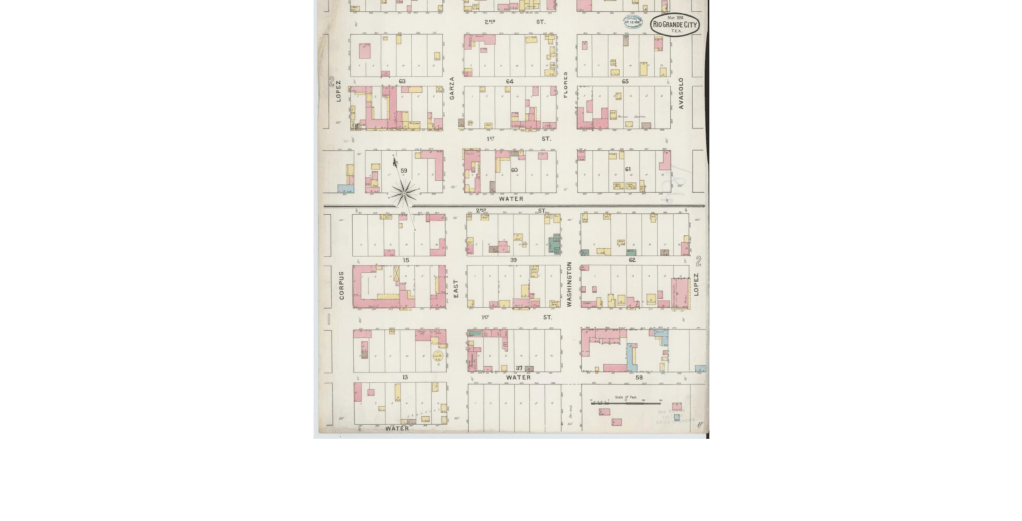
Sanborn Fire Insurance Map from Rio Grande City, Starr County, Texas. May 1894.
I’ve walked these streets before, decades ago. We’d drive the six hundred miles south for Christmas, for funerals, for two weeks every summer while Dad served his time in Army Reserves. What I remember of the streets isn’t much — the panaderia with the best cochinitos, the two story building pockmarked by time where Papa Romulo ran his tailor shop & his cantina, the shops we never entered, the shops that used to be. With every walk down those dusty hot sidewalks, I wanted to get back to the house of my mother’s childhood, back to the pomegranate tree & the screen door with the bell, back to our BB gun and the mesquite trees with their undulating thick branches shading the packed dirt. I haven’t been down those Rio Grande streets in decades.
As I’ve said elsewhere, there’s little there for me now but dusty graves & deep memories. My mother’s childhood home, the only home I knew there, has bougainvillea where the salt cedar once soared, tin foil on the front windows. My brother Raul has the aluminum lawn chairs from the back yard, chairs sunbaked over time from candy-apple red to rust. The display cabinets from Mama Tulitas’s store are in my parents’ garage, once stocked with fresh bread, now packed with gardening equipment & hundred-year-old hat blocks. Not everything is lost.
Recently, I zoomed in on these Rio Grande City streets — or to be more precise, on an alley where my great grandfather Papa Pedro worked as a blacksmith. Click by click, I walked those streets, found that alley, advancing by digital leaps, the camera of all things on a tab nestled between a recipe for Dijonnaise grilled chicken breasts & student submissions waiting to be graded, the camera lens advancing fifty feet at a time in pixelated bursts, landing on sharp focus high-def ground. Getting closer & closer to the terrain if not the hour of this time of hard labor, of honest labor, of manhood, of Mexicanness I never knew. A daydreamer at heart, I don’t need much to conjure up a living laughing version of the strong, serious, mustached man in the photo (one of two we have of him). The digital search / journey awakened nothing my mother hadn’t already shared decades before with the five of us kids walking through the Valley heat, interrupted by her childhood friends running errands. We rolled our eyes. They ignored our boredom, relishing the blessing, the surprise, the luxury platicando. A pin was always in a map somewhere. Now I had seen it.
I went looking for it again in the Library of Congress and found a Sanborn Fire Insurance map of Rio Grande City from May 1894 (one of two the LOC hosts). Even back then, the town had a meticulous geometric order. Sanborn marks the equidistant east-west water lines running beneath a land where water means citizenship, where water means life, where water is a commodity almost as valuable to find as natural gas. Each lot in nearly equal proportions with its neighbors, each street in rectilinear dignity with / apart from the others. From this gods-eye view, Sanborn commemorates each owner shaping the stuff of creation, innovating & compromising within the perimeter of their respective lots, making this little postage stamp of a world their own.
Some homes built as far from the “traffic” as possible. Some buildings (businesses, clearly) constructed as close to the street as safety & city codes will allow. Sanborn color-coded the maps, a different color for each material. Tile. Stone. Wood frame. Brick. Sanborn Fire Insurance imagined a plan for one particular kind of disaster, the kind of disaster that struck one mile west of where the blacksmith shop once stood, that struck my mother’s childhood home on Fairgrounds Road at the Rio Grande City home I knew, that struck July 2, 1981, my twelfth birthday. I had spent that night fifteen miles away at my paternal grandparents’ house in Roma. My great grandfather was long dead. I don’t know where the water lines were in 1981, but I see now where they were in 1894. The time of Sanborn’s map was a time of caution, of preparedness, a time of knives & saws, of clothes lines & woodstoves, of hand carved existences.
My great grandfather had strong rough hands moving quickly in the heat, moving briskly from fire to anvil. He bent iron. It was right there, just outside the frame of the map.
For most of human history, if you wanted to make a point, you had to push. A stylus into clay. A chisel into stone. In certain cases, you could be more delicate. A brush onto a canvas. A quill onto parchment. Horsehair & feathers—something must be shorn, something must be lost, for something to be remembered. The meaning is made by hand. A sometimes slow, near-permanent process of setting & resetting, replenishing & depleting the ink, stroke by stroke. Until 1795.
A scientist serving under Napoleon invented the pencil during perhaps the bloodiest of years in the bloody French Revolution. It was complicated—well, maybe for a scientist it wasn’t. Graphite is one of the softest solids. Mix graphite with water & clay, heat the compound in a kiln to 1900 degrees, and you can shape it however you like. Or, in the case of the scientist Nicholas-Jacques Conte, you shape it so that it slides just so into a kind of wood sheath. Your hand stays clean, your pocket stays clean, and ideally, you can write to your heart’s desire, can write as long as the graphite holds.
Oh, and it’s graphite, not lead. They mistook it for lead when they found huge deposits of the stuff in Bavaria in the 1400s. Huge deposits of a kind of pure carbon. Beneath fields, beneath farms, tucked into hills & caves, humble walls & surprising depths, mounds & chunks of rough dark fragile stuff.
This stuff (soon to be called graphite) was wholly unlike the earth itself, the earth which took on the qualities of the seasons & the elements—earth could become mud, could become soil, could become dust. You depended on the earth’s variety. You could even come to appreciate its smell, knowing that the scent of the earth hinted at what emerged from the womb of its wet darkness year after year. Not this. This medieval discovery of dull gray deposits wasn’t quite dross, wasn’t quite precious, wasn’t lead.
You couldn’t build on it, you couldn’t plant in it, you couldn’t eat it, you couldn’t yet sell it. You couldn’t help but notice how persistent it was, how it filled in the lifelines & love lines in the palms of your hands, how it worked its way into the finest of swirls at the tips of your fingers, how it wrote so much on you without ever seeming to diminish in itself. (If you could keep it from breaking in your hands.)
Maybe they discovered by accident that this pure carbon could mark things easily, like chalk. Wrapping this graphite with string, humble shepherds began marking their flock. Imagine a single shepherd arising from under a tree, the grazing hours of his slow woolly charge over. Imagine him counting nine ten eleven and again with wide eyed urgency NINE TEN ELEVEN, counting & shouting, counting & shoving the sheep still to recount until he confirms one sheep missing. Imagine him leaving the rest behind, at the mercy of the elements, at the mercy of the wolves, leaving the rest behind to go quickly into the open country, seeking the lost sheep. And when he finds his sheep, sees his mark on its wool, he sighs, thanks the heavens, gathers him onto his shoulders, gently chiding the lost sheep with each joyful step back to the flock. We all know where we belong. We all know that such a line can bring order, can shape the stuff of creation. (All lines can.)
Lines on wood, lines on rock, lines on the ground. Not to decorate but to demarcate. To separate this from that. (A kind of godly labor—the god of Genesis creates largely by means of separations & distinctions: night from day, light from dark, the sea from the land, one fruit-bearing tree from the rest of the garden. A divine story written only once.)
Kids must have played with it. Centuries ago, children barefoot, dressed in rough tunics their mothers made, a thin rope for a belt, soft hide for shoes. Centuries ago, when the wild was closer to home, when it was maybe just a stone’s throw from threshold. Kids would go into the hills, knelt at the edges of mysterious blackness, an older kid dragging his hands along it & holding them up to his little sister, hands stained through & through. They rubbed it on each other’s faces for fun, or maybe they grabbed a pinecone-sized chunk of it to throw against a tree, to smash against some of the flat stones that served as staircases up the hill. They got scolded when they got home for sullying their clothes (or they didn’t because to live in the 1400s was to be filthy most of the time). Children for centuries, and centuries.
Until eventually other kids altogether less free rubbed sleep from their eyes while they packed pencils in zippered school supply bags. Pencils & sharpies, scissors & protractors, highlighters & post-it notes. A tool kit for a developing mind, all tools tucked into the same backpack with their crustless sandwiches & sliced fruit. And one tool that Nicholas-Jacques Conte hadn’t considered in his original pencil. These school children’s pencils are balanced—a blade-sharpened black point and a soft tongue-pink eraser.
For sixty years, pencils were practical & variable. Different densities, different sizes, different shapes, most with some sort of flat side so that they would not roll off a surface when set down. Decades of rough drafting. But the stakes were still high—the tracks of the pencil’s journey, the record of the marriage between mind & hand was near-permanent. Sometimes, some pencillers used bread to massage their lines into oblivion, like a magician stroking a bright coin against their flat palm before the yearned-for disappearance. Perhaps with a damp cloth, you could perform a similar magic, smudging away the hasty word choice, wiping clean the erroneous sum, removing altogether the evidence of a human mind erring & backtracking, resounding the mental depths & pivoting toward the true, the right. A pencil’s work held fast. Until 1858.
A stroke of not-original not-genius: A writing point on one end, and on the other end, the polar opposite. A piece of rubber that would also be sharpened, depending on the error to remove. Hymen Lipman wrote / wrought a tool of & for human ingenuity at its messiest, a tool of re-vision most deliberate, the very tool we know today. In an ironic turn of historical events, Lipman had his patent erased by the Supreme Court, the great righter of wrongs, the great writer of rights & wrongs. Lipman had no legal claim to a patent, having merely merged two inventions; Lipman created nothing so that we could create anything.
So we do.
Following the dotted lines that guide us letter by letter into shapes of meaning, words we’ve only heard. And a few years later, connecting dot 3 to dot 4, bringing shape to the empty quadrant of the kids’ meals menu. And a few years later, showing your work—substitution & misstep, reduction & inversion—narrowing line by line till the barest most declarative of meanings, X equals, the end to the erratic path from chaos to value. Later still, entering testing rooms, sitting for hours with everyone across the country your age, a bored adult at the front, while we bubble in our futures, recognizing that there is often no correct answer but merely the best possible answer. Until things really matter.
And you reach for a pen.
*
*
*
[shavings, that is, pieces that never got sharpened or that didn’t fit in the sharpened draft]
Pencil shavings. Pencil apron—the part that’s the wood part that your index finger rests on. It’s called the “apron” of the pencil. I didn’t know it needed a name
The point of no return—we really use only half a pencil’s full resources before we throw it away. A pencil, though, If you’re careful, a pencil lead can last 731 miles.
St Luke’s Catholic School—they had NFL themed pencils at the store. They wouldn’t let you choose your team. You’d give the lady the money, and she made a big f7cking deal about reaching into the box without looking so that nobody could accuse her of letting you actually choose the pencil you wanted. One time I gave her my money, and she locked her eyes on mine, reached into the box & handed me a Tampa Bay Buccaneers pencil. In the mid-70s, Tampa Bay had the worst team colors in the entire NFL, and I was so pissed off, and Jimmy D came up behind me and laughed about it. Jimmy was a rich only child asshole whose mom had bought him a whole dang box of Dallas Cowboys pencils, whose mom one time asked my mom to have me come spend the night at his house, and I didn’t want to, but my mom told his mom I would, so I did, and at the end of this annoying afternoon & evening trying to have fun with this kid in his huge house with loads of toys & things, we move over to his bedroom to go to sleep, and I see that he had this huge room all to himself with a bed all to himself, and I’m coming from a house where I share a room & a bed with my brother, and Jimmy’s bed has satin sheets like a girl, and I was so confused because he was such a loudmouth bully, such a little prick, but he had these satin sheets all paisley patterned in royal purple and forest green, and I thought This jerk oh my G-d, and I just couldn’t wait to go to school the next Monday to tell everybody that he slept on satin sheets, but as I got into the bed I couldn’t figure out why this whole thing was weird, and I worried that maybe I alone would think it was weird, and I figured on second thought maybe I didn’t want people to know that I spent the night there because we weren’t really friends, and I realized that my mom pitied him, that my mom knew he was a little prick, and I’m there in this big satin bed with Jimmy, realizing that his mom must have known he was a prick with no friends, which was why she reached out to my mom because I was known as a nice smart boy (I was a nice, smart boy), so I fell asleep, having prayed to myself & having decided that I wouldn’t tell anybody about his sheets, and now here he was laughing at me, and I wanted to shove the pencil into his ear, so I imagined doing it & him crying & bleeding. That all happened. It happened just like that.
Pencils tucked behind ears, one of the most natural resting places for a thing unnatural
Version 1 of the paragraph beginning “Kids must have”: [version 1] Maybe kids played with it. Centuries ago, children barefoot, dressed in rough tunics their mothers made, a thin rope for a belt, soft leather shoes. Centuries ago, when the wild was closer to home, when it was maybe just a stone’s throw from threshold. Maybe kids went into the hills, knelt at the edges of mysterious blackness, an older kid dragging his hands along it & holding them up to his little sister, hands stained through & through. Maybe they rubbed it on each other’s faces for fun, maybe they grabbed a pinecone-sized chunk of it to throw against a tree, to smash against some of the flat stones that served as staircases up the hill. Maybe they got scolded when they got home for sullying their clothes, or maybe they didn’t because to live in the 1400s was to be filthy most of the time. Maybe.
Standard yellow pencils. The hexagonal design — what other things come in groups or sides of six?
Her hair is lathered & twisted into the unicorn peak she likes.

I lean over, and she slaps the bathwater, giggling at my dripping face.
I mock-scowl and reach for the bright red bowl buoyed in the undulating foam.

We test the water from the tap before she leans her head back, her throat all a-glimmer,
her tiny shoulders perfectly round—I shield her eyes with one hand, pour with the other.
Later, a spiral of water at her feet, the clean girl floats, arms outstretched, embracing it all.
And in the end, things happened quickly.
After years of protracted silences
& painstakingly unmended fences,
we both woke to an email finalizing
the divorce.

Neither of us knew that this would be
the wished-for day. She woke in our house,
I in my shabby place, grousing
internally about the other, replaying
old arguments.

And now there was nothing left
to divide, nothing to fight over.
Fees prepaid. A finally-shut door
kept us safe & far far from one
another.

On opposite sides of town,
the baristas told us,
"Have a nice day."

"You too."
"You too."

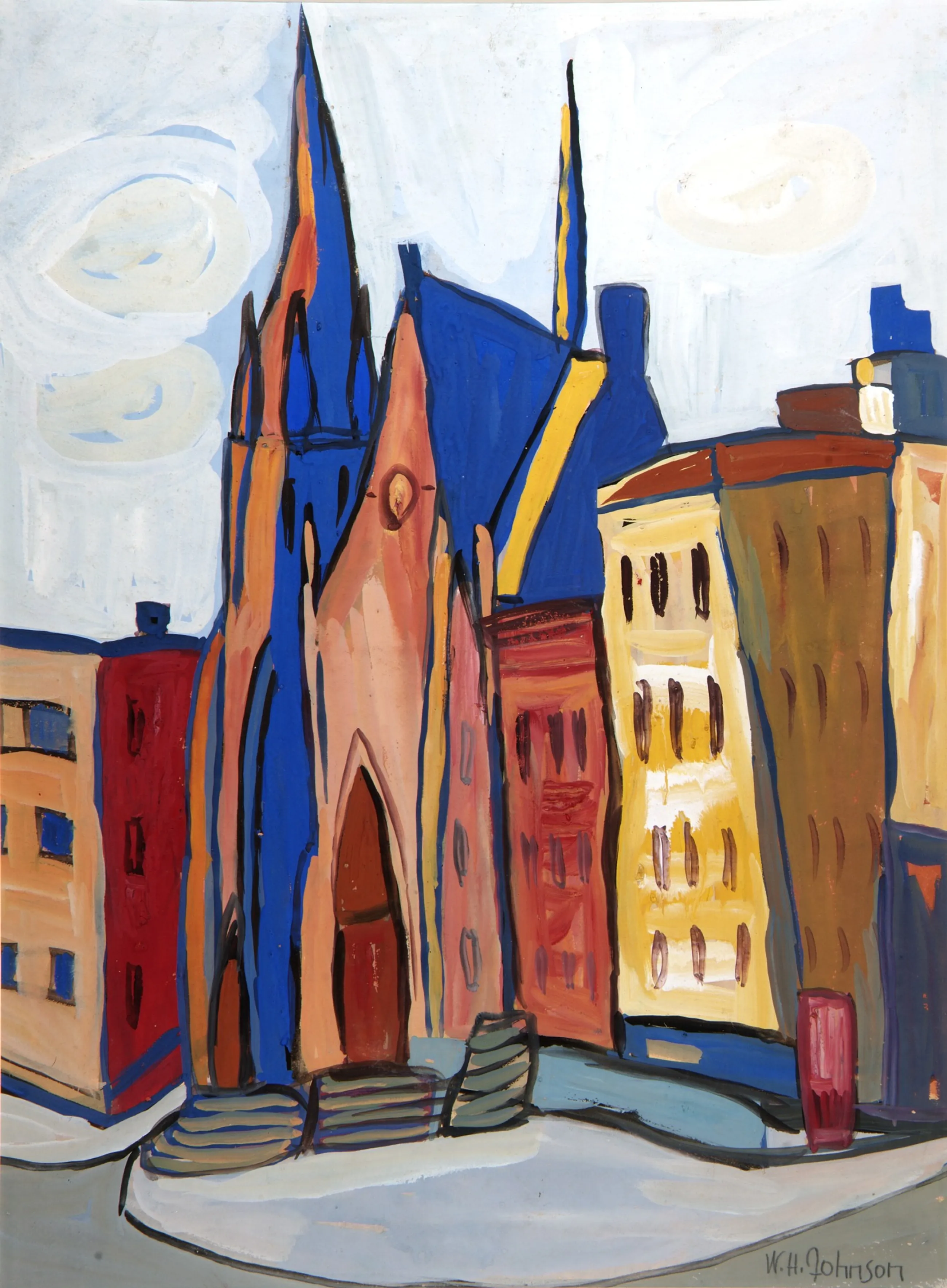
This was written for a National Poetry Month challenge, an April Fool's Day poem, something untrue. Sometimes when I write about me & my wife, I use that image, William H. Johnson, Café (ca. 1939-1940) but not always.
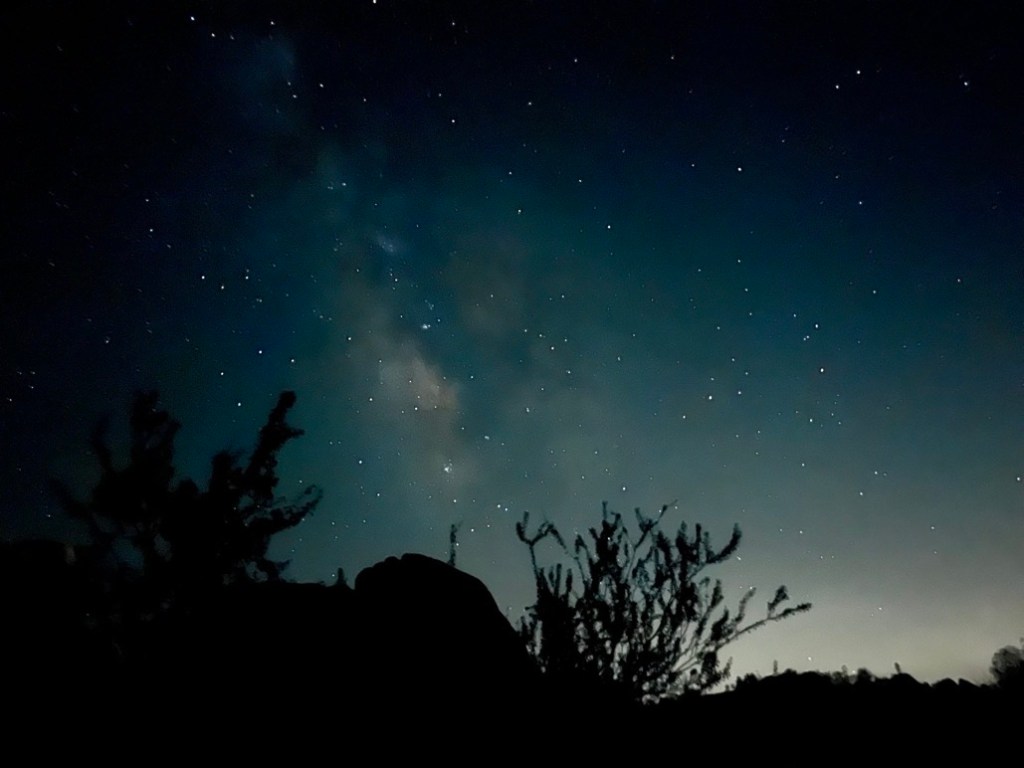
Ruben Quesada, Milky Way in Joshua Tree, July 2022
The first people created were far too large, modeled after the gods themselves. Their uprising was inevitable & ferocious; it saddened the gods deeply to kill these other selves.
The second people created were far too small, no match for the beasts & the birds, far too vulnerable for the elements & the water. The gods, deliberate in their design & construction, were nonetheless confused by how weak these small things were.
The third people created asked far too many questions, looked too deep into divine will & natural law. The gods agreed quickly to kill them in their sleep. Good riddance, they said. Centuries passed with the gods mostly happy with things as they were until a child fell from the sky.
The gods, alarmed by the fiery streak in the sky & the distant thud, rushed to probe this latest remnant of the heavens. Soon they halted their approach, ambrosia’d mouths agape — it was not the celestial boulder they had come to expect but instead beauty in motion. Two ears rather than one, two eyes rather than eight, one mouth rather than two. Limbs lithe rather than warlike, and most importantly, a proportion that fit the landscape — the beasts below him, the trees above. No god dared to say what they were all thinking: This creature in every way exceeded centuries of divine skill & taste, imagination & will. If gods prayed, one of them would have said that this star child was clearly the reward for long unanswered prayers.
The star child arose slowly, eyes wide on the surrounding gods. One god plucked a nearly-ripe fruit from a tree, tiptoeing closer as the child gulped. The god kept his honeyed eyes on the child, ignoring the iridescent lock of hair of hair fluttering across his face, his eternally powerful hands twisting away the stem and burnishing the fruit to a luster worthy of the child before placing it on a broad leaf. The star child ate, his body tensed, his gaze surveying possible gaps within these assembled predators.
Each day, he tried to hide from the gods, who grew increasingly enamored with him, giving him pet names & brazenly lurid glances. They brought riches of divine variety & luxury, each new gift as useless to him as the previous. With time, the star child grew more beautiful, his radiant skin darkening & glistening in the sun.
In a rare moment of near-privacy, the hawk god asked, What can I give you, child? A view from the highest peak in the world, the star child said. Now? Now.
Hours later, they alight gently on the snowy windy peak hidden in the clouds. The star child looks skyward, speaking a language the hawk god has never heard. He wants to go home, the god recognizes. The hawk god flies him above the clouds, into the heavens, higher & further than you can imagine. Nobody sees either of them ever again.
*
The gods’ attempts to recreate this star child were slow & bittersweet. All missed the star child so much that any discussion of improving upon the star child (removing the tail, adding a fifth finger) was met with swift rejection and often with tears. Model after model, version after version, was crafted. Centuries-old collaborations descended into factions & mistrust. Spies looted divine designs so frequently that craftsgods created false decoy drawings & coded languages impenetrable to even the most shrewd gods. The landscape was littered with near-children — limbs & fur, entrails & adornments, color swatches & bone fragments scattered to the animals & the winds without a thought.
One night while a design spy rummaged through scrolls of false designs, prototypes (designed to evade all gods save their creators) stealthily crept out of the workshop & into the night. Side by side, they stole through the night, programmed deeply with the command evade, wait, evade, wait. The gods had not imagined them to be fully thoughtful creatures. Some connection to beauty, however, had survived the disappearance of the star child, something so persistent that in the prototypes escape, they paused.
They saw the stars. They forgot what they were waiting for, what they were running from. The night sky wheeled slowly, an eruption of shimmering & cloudy white, punctuated by the paths of star children unseen & unknown hurtling through the heavens. It was brighter than the workshop ever was, bright enough that, had they looked at one another, they would have seen constellations innumerable & not yet named mirrored in one another’s eyes. A movement too subtle to be called a breeze stirred across the plain, bringing a sensation that brought them back to earth.
A beauty ennobled the air they breathed, but only the air in their noses. They didn’t know what it was; it was nearby bush just coming into flower. Approaching the scent, they found their bodies spinning around. A noise nearby compelled them to assess the danger before they could think. The source of the sound? A yellow bird the size of their thumbs flew from a tree, a twig in its beak. Their skin tingled, their hearts beat like they’d never know, their eyes filled with tears. They were terribly afraid.
They walked & started over & over again — each brook, each lizard, each noise awakening in them a fear they hadn’t learned to ignore or temper. Eventually, they collapsed in exhaustion & hunger, their arms around one another, an embodied shelter more than an embrace.
They awoke to a terrain flattened & hardened, far from its varied & colorful beginnings. The gods had used & reused earth in creation after creation so many times that the undulating earth had lost all but its highest peaks. The valleys, created for divine love making, had been filled so long ago with near-human raw materials that only the shallowest of indentations remained. The smallest of animals nestled there at night. Lakes, having lost the protections of this terrestrial rising & falling, ran to the horizon & evaporated. All these escaped prototypes saw for miles upon their first free morning were fish gasping & flopping.
A passing god explained to them that they could eat the fish. They did, weeping & apologizing. A landscape of sorrow & silt & filth & the bones & entrails they spit out were more than they could handle. They begged to be killed or returned to the workshop.
And the sun was enraged, his palette & canvas ruined. His rays no longer danced on the gently rippling waves but practically disappeared atop the ever-cracking earth. He could no longer play & delight in varieties of shadow but had to reconcile himself to the small lines threaded by the bones covering the blank terrain, narrowing at noon to a series of nearly invisible points. It was no longer beautiful anywhere, he thought. It never would be again.
she said i have something to tell you
i was in my room getting changed
from a day at school that time of day
when supper & homework are
out of sight & mind when we're just
being & living & exhaling
or when we remember
to tell each other things
that there's no right time for
so now is the time yes honey
without preamble & with a confidence
that belied her age (or revealed
my misunderstanding of that age)
she told me she was attracted
to people regardless of gender
i wasn't disappointed & i wasn't
afraid & for a few seconds we both
relished the trust & the truth said
& i knew that others might worry
that this was a fad or a phase
& she knew this too & knew so much
more than this too but that was
for another time & we both knew
that this was the time for me
to say what i'd say & we both
knew what i'd say so i said it
& we hugged & we went
to pet the dog & wait
for supper
Once upon a time, there was a boy who could remember everything.
Since so much of childhood is about obeying, this boy’s memory went unnoticed for years, even by the boy himself. Each perfect score at school showed that he was smart, when in fact, he couldn’t have earned any other score. This recall they saw as wisdom — maybe it was. At each family gathering, the boy called relatives by name, no matter how long since their last visit, which showed that he was a good boy, a kind boy. He was — he really was. Each joke, each kids’ song, each movie he could recount with precision, which made his friends love him. He didn’t know he was special — just that he was good, that he was loved. And that everything he had seen or heard, tasted or felt, was with him all the time, was right there.
Now you might think that this will be a story about the burden of memory, at its worst, at its heaviest. This will not be that story. This boy who could remember everything … may G-d protect him from that story.
He preserved an exact … not a copy of each moment of his life. He preserved the essence of each kindness that his friends bestowed on him, the essence of each smile of each passing stranger. Daily trifles that cost them nothing effortlessly became treasures that never lost their luster. This wasn’t brain recall; it was the omnipresence of full hearts.
One day, the boy came upon a classmate crying in a nearly hidden corner of the playground. She was trying to hide, but childhood (you remember) is so very public. All injuries, insults, hand-me-downs, bad haircuts, runny noses … they’re all on display. There is nothing (you remember) so beautiful or so vulnerable as a child, as this girl on that playground that day.
The boy, a kind boy, a loved boy, would never walk past such a girl. Even this girl, who was a classmate but not a friend. He had heard her name once — which was all he needed. He spoke her name. She looked up.
Imagine a conversation about pain, all the language direct, stripped of nuance & detail. Imagine the boy (whom you’ve been imagining this whole time) nodding & listening. Imagine the layered vulnerability of the girl, no longer hidden here, still crying here, to this boy she didn’t really know. But she couldn’t help herself. She kept speaking.
A long story of personal loss, not surprising, not traumatic. You don’t need to imagine that part — you, who remember loss, the loss of someone you loved, someone old, someone so old that they had become flattened & simplified in your mind to their oldness primarily but not exclusively. She was crying because an old person–a person that at some level she knew would die soon–had died too soon.
She had left things unsaid, certain that there would be time. And now there wasn’t time. But there was the boy, who said, “Tell me.”
She told him. He would never forget, and neither would she.
When you hear that they’ve taken their own lives, your first instinct is a selfish one, to remember or exaggerate what relationship you had with them. What did they think of me? What’s an anecdote I’llhave at the ready?
You’ll say that you’re centering your grief, and you’ll wonder if you’re centering yourself. You’ll seek some artifact, some detail that will reanimate them (or at least their past self), awkwardly fumbling through the overstuffed kitchen drawer of your mind–no, they didn’t play [xxx], they played [xxx]; no, they weren’t in [xxx], they were in [xxx]. Their [xxx] was [xxx] years older–or was it [xxx] years older? So you pull the yearbook from the shelf.
You’ll read into every image. This was the senior photo that they scheduled & dressed for, that they drove to & performed in, a parent just off-camera nudging them into a smile they hadn’t shared with family in years, hoping that this will be the year it’s all better, that a year from now, they’ll depart for the future of their dreams (or of someone’s dreams), a landscape far from the shadowed horizons of their now. Their smile lasted as long as the shutter click, as false on the page as it was that day. You can almost … actually, you can easily see it.
Or maybe they’re smiling, really smiling. It’s (their last) summer at home. They’re not writing essays yet. They’re not whittling down schools yet. Every adult in their life is waiting for them to take the next steps they’ll share with their entire class, some of them life-long friends, friends to the end, truly.
They’re months away from the long absences from school, months away from the long stay at [xxx], the best possible place for them. Months away from our sighing, relieved that they were saved before they could hurt themselves. They haven’t yet written the goodbye. They haven’t yet [xxx] late that [xxx] night.
They’re months away from telling counselors, “When I get out of here, [xxx]. I understand that I have a lot to live for, and I need you to know [xxx].” They’ll be deadly serious.
They’ll be released, a plan & a prescription in hand. They … they look good, to be honest. They know they’re being scrutinized in their face & watched carefully behind their back. They might even graduate. It’ll feel like it should–like it never happened, like they’re fixed. After months, we sigh, relieved, and think of the next semester, the next class, the next batch to grade & graduate. When all (well, when most) is said & done, you forget to ask after them.
And then.
You’ll find yourself numb & cautious. Some colleagues are wrecked; new colleagues (who never met them) know how to read the room, poker faces & polite questions, euphemisms & careful terms (“completed” not “committed”). You’ll wonder quietly how to walk the emotional tightrope.
You’ll all walk into a big room where someone delivers the big news. You’ll walk your kids to a smaller room where you ask how they feel about it, about them, about this. You’ll avoid saying that there’s no why in moments like this. You’ll wonder–G-d forgive me–who might be next.
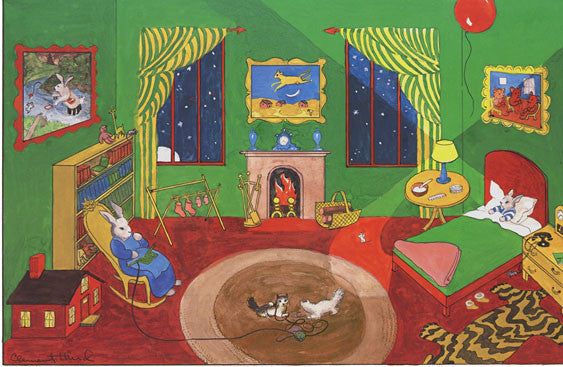
Image by Clement Hurd from Margaret Wise Brown’s Goodnight Moon
There's a ritual in our house, a nightly laying on
of hands. Kids come, teeth brushed, laptops stowed,
to our bed. They're bigger these days, stretching
the length of our own bodies. Showering love owed

on the dog, a pure-breed full-grown runt: Buddy.
Underdeveloped tear ducts stain his fur deep
brown, damp symmetrical tracks from
eyes to snout. He accepts the love, from kids sleep-

ily giddy. They push aside his squeaky toy &
the gnawed rawhide, its meaty marrow drained hours
or days ago. They lie down nose to nose with him,
holding his head in their hands, fully calmly ours.

When younger, they lay down hoping to stay the night,
spooning against his back, draping an arm
over his neck, their shared breaths a warm gentle metronome
marking the slow rhythm of a dying day, far

from the solitary beds where they belong. They
lingered; we let them, way back then, for a time. A family
at rest, warming the same bed. Pushing tomorrow
further away, drawing closer as one, sleepily,

to the symbol, the mascot, the blessed
embodiment of who we are, of how we love.
Many students will never write for fun again, will never choose to read a poem again, will never [sigh] read a book if they don’t have to. This time, this concentrated time, this shared & free thinking is all too often fleeting. They’re eager–most of them–to leave by the end of it all, they’re eager–many of them–to leave it all behind. They know what they’ll be leaving behind, and they won’t much care.
And I will not care that they won’t much care because I know that this carelessness too is fleeting. Rooted in even the most careless, when they think of it at all, is some respect for my respect for our work, for our words together. And at some future reception, they’ll tell me, unprompted, “You know, I still have that book”.
A book they’ve held over & over again, that they’ve packed up & moved, that they’ve unboxed & put on a shelf, that they’ve preserved for years, maybe that they’ll hold & carry, store & stare at (even if unopened) for their entire lives.
To them a symbol, to me a record, of their once-deep thinking, their once- and maybe still-widened mind.
Inspired by my discovery somehow of this word–se·rot·i·noussə-ˈrät-nəs : remaining closed on the tree with seed dissemination delayed or occurring gradually
You celebrate the first steps
which look like what they are,
a controlled fall. Eyes wide
in joy, in disbelief.

The steps grow varied
in pace in path in purpose.
You're often alone, doing your best
to keep moving somewhere somehow.

Eventually you walk without thinking,
your horizons & paths narrowed--
appointments not destinations.
In rare moments, your eyes open,
your feet fly, knowing nothing
can hurt you till you stand still.
The doors are heavy, falling shut with a slow ease & finality. The space is sacred to some, to those who work it, to those who hope to cast the spell.
Every theater has its own relic’d beauty–loose hinges on the front & center seats, faded fluorescent tape marking the limits of characters long silent, scarred lines marking the props dragged season after season.
The heights are seen only by the lucky. Sandbags & catwalks, lights & innumerable cords. Rows of scrims, depths of story, layers of place.
You get on stage with the rest of this unkempt bunch, untied Converse shoes & loose t-shirts. You shake the tension from your shoulders & join hands, centering yourself in this song & dance, this ceremony seen only by the lucky, performed only by this loving few.
Let us play.
Thanks to Ruben Quesada for the guidance during a workshop in July 2022, when I wrote a lot, including this draft, when he challenged us to capture a time of joy.
Tell yourself as it gets cold & gray
that it is going to pay off.
The planning & grading,
the commenting & designing,
the paperwork & meetings. For you
there's the chance to reset over & over.
New units, new semesters,
new years, new courses,
December punctuated loudly
with good news from seniors,
a future they hoped & worked for,
acceptance, relief.

Tonight as it gets cold,
count the days, and know
that there is never enough time and
that there is always just enough time.
It resolved, or it didn't
in ways you'll never know.
They learned & they struggled
in ways you'll never know.
And you'll start it all again
sooner than you can imagine.

And if it happens that you cannot
reconcile yourself to this necessary
end, this final weeks, then delight
in the joy of your students, for whom--
in the best possible ways--
you were just another adult
standing in the current of their lives,
guiding them, and telling them,
Good morning. Good job. Goodbye.
She had high hopes for a tree that flowered.
So many in this neighborhood were planted
for another place, dense canopies
you might see in a movie or
in some part of town
richer & older.

She hired an arborist, a kind & fussy man
who called each tree by its Latin genus name,
who spoke surprisingly good Spanish
to his crew scurrying high above,
chainsaws swinging heavily
from their loose belts.

They removed the old tree, its spiky circular spores
tucked in the grass for years after. She watched
as they lifted the new tree from the bed of the truck,
a canvas bag diapering its thin roots.

They drove spikes into the earth surrounding
the hole, upturned & fragrant. The roots of the old tree
were left to wither in the unseen deep.
She imagined the burst of color to come.

The tree grew & flowered, less bright
than she had hoped. A freak cold snap
historic & long chilled the tree to the core.
Her husband watched it for weeks,
certain something could be saved.

Different men were hired to make rough cuts,
feeding the fallen branches into a machine
at the curb, mulching them briskly
right before their eyes, dust catching
in the brittle grey grass.

It grew the next year thick with leaves
near the trunk. Branches will come anew,
they thought, will come later.

It flowered as before. It flowers
each year, waving gently
in the piercing Texas sun.
“I think everyone should be able to pick a word that moves them, and occupy it” (Eileen Myles, in the afterword to this anthology)
My word came to me late, in a language I don’t know. I can’t write it, and I do a poor job saying it: רוּחַ. Ruach, that is, spirit, unless it means wind, or unless it means breath, or unless it means something else.
I’d like to be that רוּחַ heard before it’s felt, almost never seen, energized & untroubled by obstacles. Even those windbreaks I’ve seen (straight, high in their fields) are flat & small in the full force of a vast & powerful רוּחַ.
I’d like to be that רוּחַ that swells & enlivens each living being. Enriching the blood imperceptively, autonomically, feeding each cell from head to tail, then disappearing, returning seconds later all life long.
I’d like to be that bold רוּחַ I once was, alive in the spirit. G-d moves within me, I’m certain, though it’s been a while since I occupied the spirit, since I prayed with that presence, since I prayed for that presence, since I prayed. The spirit calls often & in ways unimaginable. Let all who hear it come, let those who are thirsty come drink the רוּחַ like water, drink it without pride.
This varied earliest holy רוּחַ … the word came to me long after I’d felt it, long after I’d embodied it, long after it had blessed me. The idea, the promise, the gift of רוּחַ has always been here. Bringing natural beauty nearer, filling my chest, nourishing the smallest most intimate parts of me, blessing & keeping me.
We were lined up by height, walking somberly to the altar, pews filled with proud parents.
Back then Granny couldn’t afford much, but she got me an Avon Batman brush as a gift.
I was at home here. Praying, singing, kneeling, and being filled with the spirit.
In the photo of our class that day, I am toothless, looking off camera. I know I was happy.

Back then Granny couldn’t afford much, but she got me an Avon Batman brush as a gift.
I imagine now the Avon lady coming to her door, Granny sitting by the room unit, looking over the catalogue page by page.
In the photo of our class that day, I am toothless, looking off camera. I know I was happy.
Years later, we found out what the priest had done to that community, to those kids.

I imagine now the Avon lady coming to her door, Granny sitting by the room unit, looking over the catalogue page by page.
What do you get a child? What do you get this child? What will his parents think?
Years later, we found out what the priest had done to that community, to those kids.
The parents, horrified in their blind trust. The newspapers laying bare the worst.

What do you get a child? What do you get this child? What will his parents think?
The trial stretched out. We knew the name of the priest--the children’s names, only whispered guesses.
The parents, horrified in their blind trust. The newspapers laying bare the worst.
And one lingering memory: A priest doing chin-ups on the blacktop, children beneath him, counting.

The trial stretched out. We knew the name of the priest--the children’s names, only whispered guesses.
We moved to the church across town. It was the first of several moves my parents made on principle.
And one lingering memory: A priest doing chin-ups on the blacktop, children beneath him, counting.
And a memory my mother shared only recently: Shouting at the pastor in the rectory, slamming the door.

We moved to the church across town. It was the first of several moves my parents made on principle.
An unnecessarily partisan homily here, an unwelcoming community there. Where is the life of the spirit?
And a memory my mother shared only recently: Shouting at the pastor in the rectory, slamming the door.
These cloistered virgins were in over their heads. I almost pity them. I tried to love them.

An unnecessarily partisan homily here, an unwelcoming community there. Where is the life of the spirit?
My parents, hungry for the body of Christ, made a home that seems now like an answered prayer.
These cloistered virgins were in over their heads. I almost pity them. I tried to love them.
What could they know about the faithful? Didn’t they know this passing stop for them was home for us?

My parents, hungry for the body of Christ, made a home that seems now like an answered prayer.
Where two or three are gathered together in His name, G-d is there. You felt it. You knew it.
What could they know about the faithful? Didn’t they know this passing stop for them was home for us?
Some have married. Some have died. Some moved on. Two that blessed me then are now in prison.

These days I walk down the aisle rarely. But I still believe. And I pray that I go in peace to love & serve.

This is my first pantoum ever, a kind of return to this moment. The title is from Psalm 34:8.
Like many things in fall 1988, this all starts
in a dark smoky place. A cafe
near campus.

She has opinions & confidence, long brown hair,
shockingly bright blue eyes.
Katie.

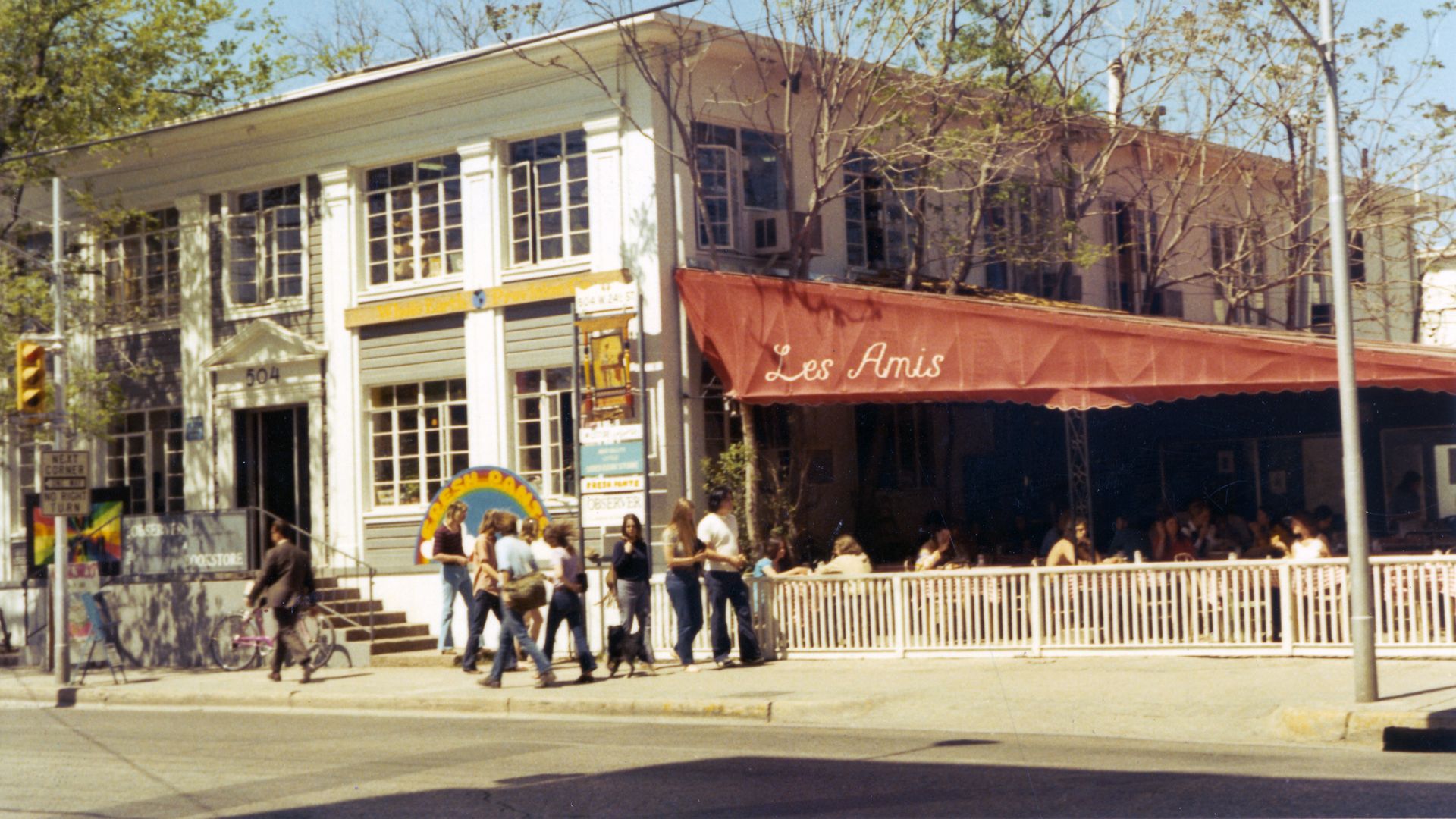
We moved to Chicago together years later,
mining that time in your twenties when everything
seems possible, nobody's married yet, and all we had
was time, cigarettes, some money, and each other.


Another writing exercise limited by one's phone number--each digit provides the number of words allowed per line. I wrote about this same relationship before, at its beginning & at its near-end.
When you’re young, you find inspiration in anyone who’s ever gone & opened up a closing door. A door shutting you out of authority or freedom, fun or prestige. A door, you imagine, that closes on important decisions related to you alone. So you relish that moment of an opening even if you don’t know what you’ll do there, even if you’re not ready to step in.
Sometimes, you’re better off in your part of the house, knowing (or discovering when it’s time) that the doors of your life are many, are wide, that they’ll open soon enough, perhaps even after you’re ready. You won’t even need to knock.
***
When you’re young, you laugh easily, loudly, sometimes at exactly the wrong moment. You feel the flush come over your ears, the tears come to your eyes. If you’re with friends, you might even get hit–the line you crossed comes at a cost, comes with a short sharp correction or recognition.
Sometimes you’re better off making sure the joke is goofy, that it’s not just a celebration of you, your cleverness. Sometimes you’re the life of the party by force. It’s okay to listen, to be kind, to be curious. You can settle for smiles instead.
***
When you’re young, candy is a reward. It’s surprisingly big. A Snickers bar is the length of a child’s forearm. A limb of chocolate. You savor & you save. The house has a drawer of sweets if you’re lucky. My house has a shocking amount of candy. Way more than I grew up with.
Sometimes you’re better off sharing it, a cake that the family slices, a gallon of ice cream that everyone scoops. There’s nourishment in this.
***
When you’re young, you put names & decorations on things. Your sheets & your pajamas, your curtains & luggage, your breakfast food & plates are adorned with cartoons & color. The process of aging is a narrowing of the imagination & the palette. You become more subtle, more calm, more quiet in the colors of your life, to the greying of your hair, your face, and the final greying which is permanent.
Sometimes you’re better off seeing through the lens of youth. Possibilities & joys open up. There’s probably even a part deep within your eye, cones & rods, there’s probably even a part deep within your mind, neurons on notice, that (re)awakens with color, with each color, with cacophonies of color. All in one place, all shimmering rainbow rainbow rainbow.
I'm thick in blood, and my heart
pounds too hard. I wake sometimes

with rapid drumming in my chest.
My wife sleeps beside me, the dog nestled near.,

my children in their rooms, sprawled,
sweating with an energy inexhaustible.

Each child, each of us, a life anew,
a lens through which to see the world

we'll leave one day too soon. To love
is to confront & frustrate mortality.

Each child, a stone placed on
the broad earth. Each child

a dimple on the cheek of it all.
There's a path that's clear & clean.
You know you could walk it,
could decide that this path would mean
something, if just for a minute.

The close packed dirt feels
solid, like a route meant for you,
each step, each crack reveals
that others before you came to

just this spot, came to a flowering
of their life as natural as
any failure or pain that stings
even in the remembering. At last,

step by step, the brightness comes,
or a rustling you didn't hear before,
and you know that this wandering from
where you were is your new life course.


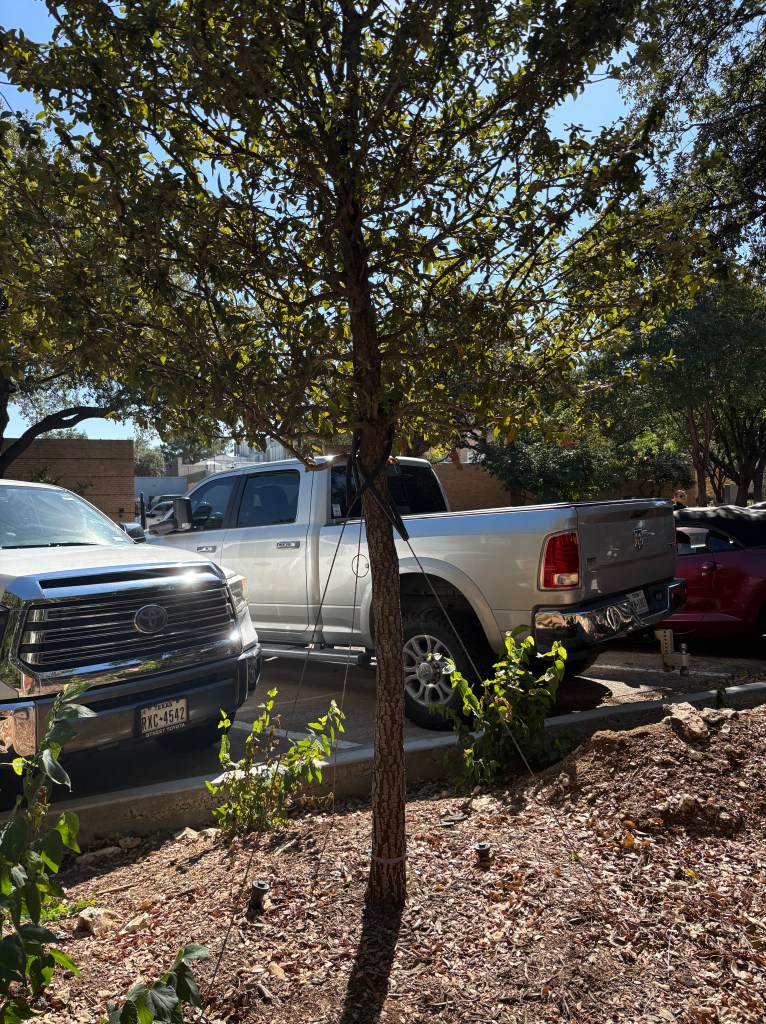
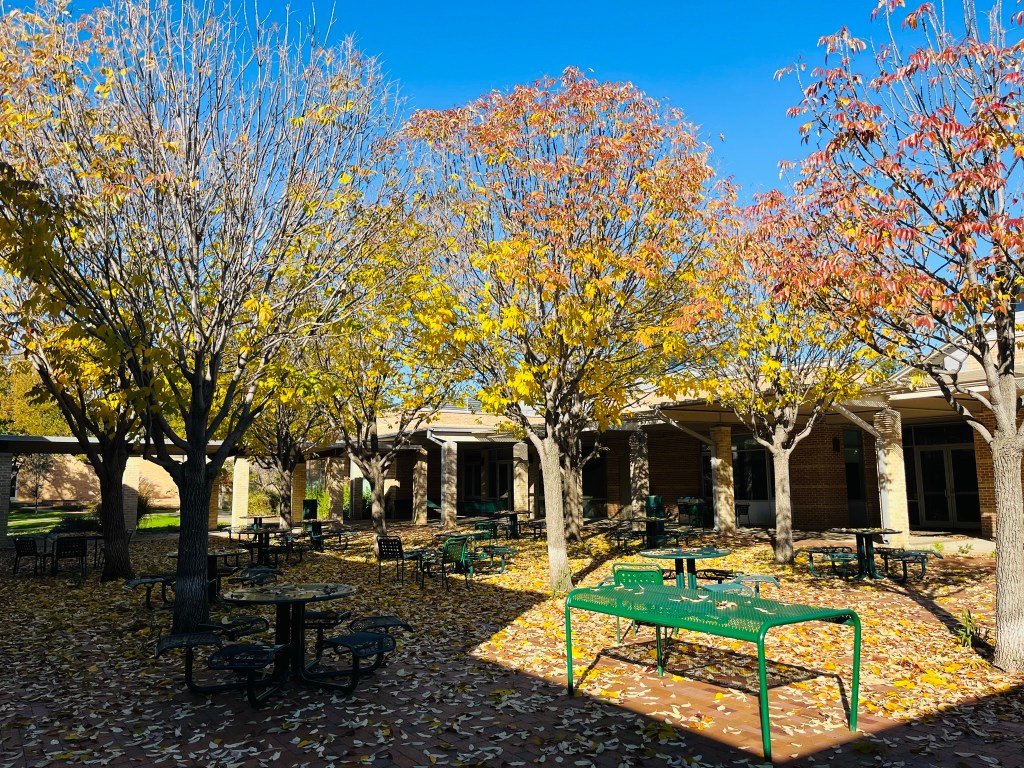
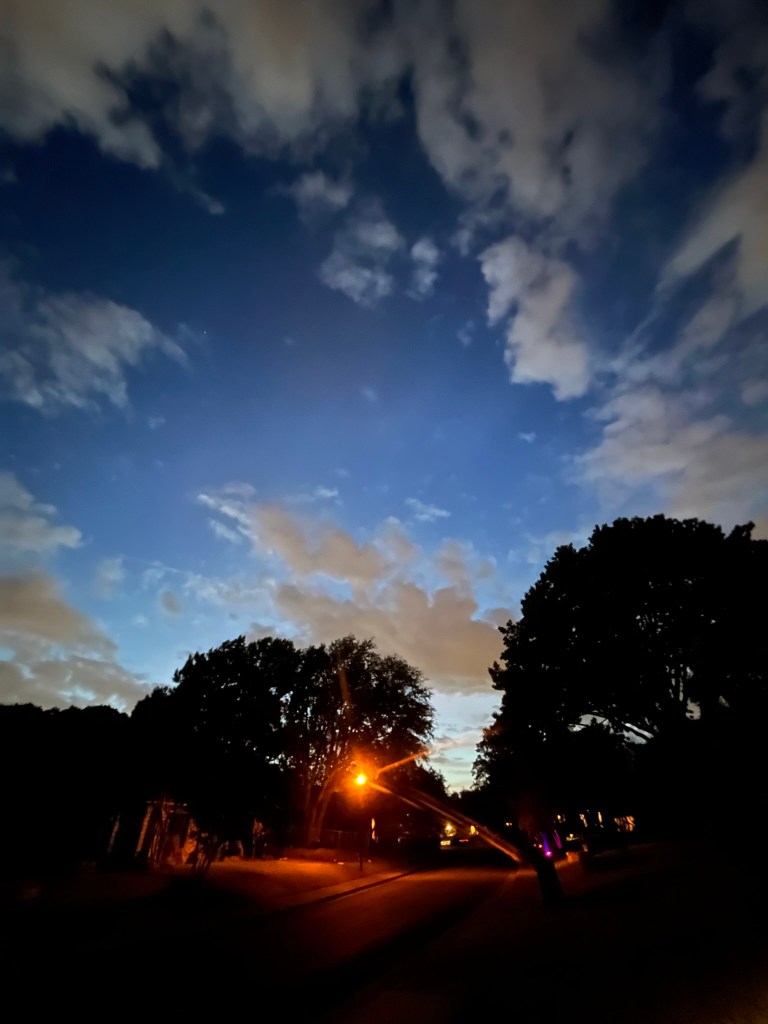
A project where students take a screenshot of a row of photos in their camera roll, and compose a poem inspired by (but not describing) the photos left to right. My four photos are above, harvested on a walk on our school campus Tuesday 10/24/23.
Tell me a story of dirt & sun & rain.
Tell me a quickening & a flourishing,
of hair-thin intent reaching
deeper & darker
higher & brighter.

Tell me of your frailty, how to be alive
is to be a miracle, to look in a daze
at the surrounding ghosts of plants past,
at the carnage common
enough to go unnoticed.

Teach me to pronounce the gentle
pushing aside of individual grains,
teach me the verb for October,
teach me the tense of your proud posture.

It's been so long since we've spoken.
The opening line is from José Olivarez’s “Escargot” in his 2023 collection Promises of Gold. The image came from here.
If I look carefully enough,
I can see all my siblings
in me. This one's eyes,
that one's hair, this one's cheeks,
that one's grin.

Distance deepens
what's on the surface.
Somewhere in Austin,
somewhere in LA,
somewhere up the road,
hands like mine do work
I'll never understand.

And as the next generation
bears fruit of different seeds,
if I look carefully enough,
I can see the roots
that ground us all.

To grow old is
to grow deeper,
to grow stronger,
to be rooted
in one another.

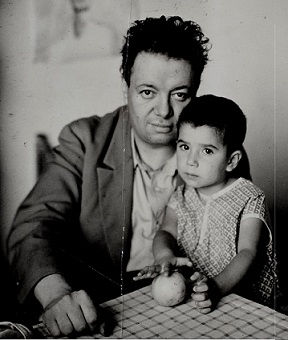
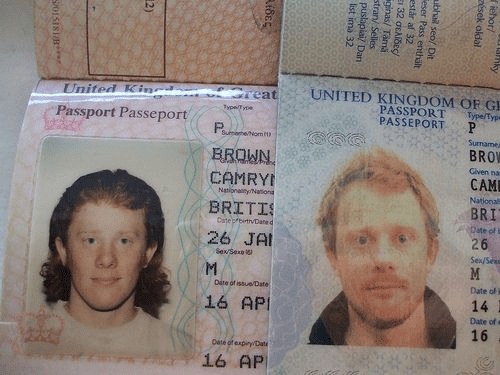
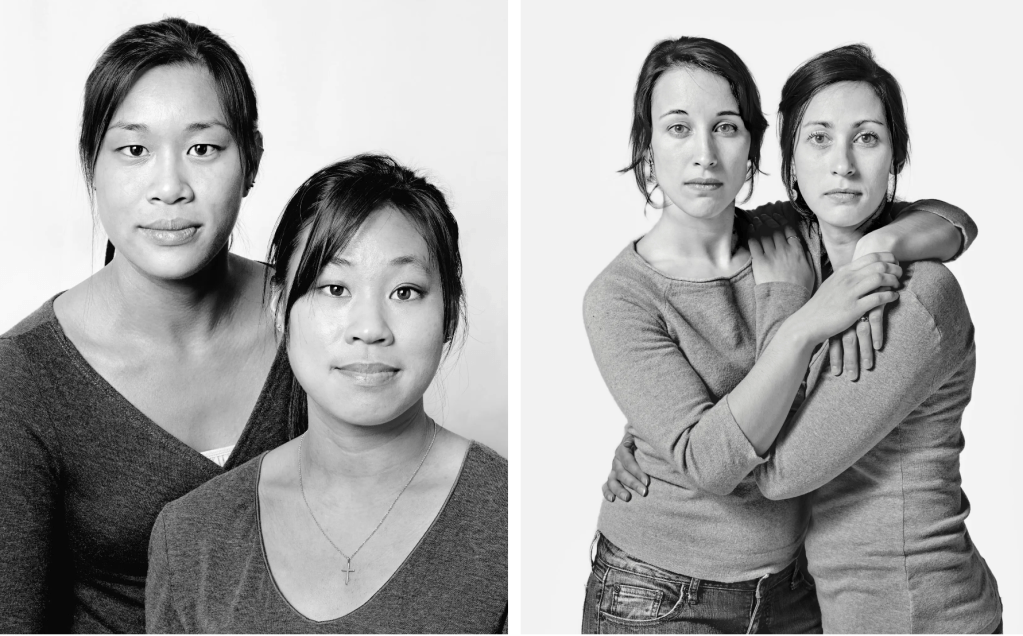
Photos by François Brunelle for an article on non-related doppelgangers. In Spanish, "raíces" means "roots".
In 2018, I decided to keep track of my reading. I kept things in that same space for four years, until things got pretty unwieldy. I took great pride in row after row of completed book, took great pride in the difficulty & variety of what was there. When I decided to write more deliberately, though, I moved my reading reflections over here.
There’s no row after row of book covers. And as I moved away from social media in 2025, I am more and more ambivalent about this part of the blog, a part that is by no means half of it, no matter what the headings & tags might suggest. I am reading for myself mostly, but at some level, I know that this space will hold me accountable.
I try to take the barest of notes these days — unsuccessfully, seeing as teacher-reading habits are ingrained in me for the best. I try to read deeply but briskly, to remind myself that I am in control of the pace of a reading, but that the pace should be close to the level of speech. To read at the pace of research would be for whatever readers happen upon this space, not for me.
Which is a lengthy way of saying that I lost track of what I read these weeks.
Kingsley Amis’ The Alteration is a horrifying and funny alternate history set in 1976 England. There’s a lot of his alternate history that was beyond my knowledge (particularly PM Wilson, the model for that novel’s pope), but I didn’t let that bother me too much. I hung onto the deep critique / examination of the cost of faith and the demands of power. And I was dazzled by the ways that Shakespeare & Keats, de Kooning & Sartre & others were reimagined in this novel that I’m certain I purchased because NYRB published it.
Plum Bun: A Novel Without a Moral by Jessie Redmon Fauset is a fantastic novel about sisterhood, about NYC, about the varieties of love, and primarily about passing. I’m pretty sure I bought it because of this article on Fauset’s astonishing career as an editor & encourager of Harlem Renaissance-era authors & poets.
The Birds by Tarjei Vesaas is my favorite book of this year. It’s one of two Norwegian books I read this month. The other, The Copenhagen Trilogy, is (depending on which part you’re reading) a stark or direct, moving or frustrating, hopeful or jarring account of growing into one’s best & worst selves; it’s a fantastic work of nonfiction, with no predictable tropes or self-aggrandizing airs. Back to The Birds, a novel centered on Mattis, a middle-aged man with mental challenges living with his middle-aged sister Hege. Their life is predictable & small — knitting sweaters, looking for work, making allowances & suffering for one another in the ways that only middle-aged unmarried siblings can. Until a sign comes that Mattis alone can read, and until a man comes that Hege alone can need. It’s realistic in the most painful ways and magical in the most realistic ways. It’s got one of the five best endings of any novel anywhere.
I definitely read more, but that’s what I can remember.
I had planned for September to be a month of slow reading. Maybe one book a week. That didn’t work out, mostly because I’m bored with most podcasts (there are exceptions) and because I’m in school again, which creates a kind of scheduling to my free time somehow. That is all to say that I powered through two novels quickly, both somewhat light-hearted, both focused on the closeness & vulnerability of family.
A friend I trust recommended Kevin Wilson’s Nothing to See Here, a novel I remembered due to its distinctive cover. The cover says a lot about the story. A lot. At the beginning of the novel, our narrator Lillian is contacted by her rich and beautiful high school roommate to take on a job. Lillian, stuck back at home in her late-20s and stuck in jobs she hates, accepts. She is to be a governess to her former roommate’s ten-year-old twin stepchildren, who have a physical condition that I won’t spoil here. It is a funny book, one that does a lot with the physical condition X factor that Wilson imagines. It is also a moving book, one that features Lillian discovering truths about parenthood that … well, that are jarring and precise, given that she has been thrust into it. There’s cool stuff in there about class and friendship, marriage and power, and it is all in the service of watching Lillian buck against / grow into loving someone and loving herself.
Somehow it made sense after Nothing to See Here to move to Cathleen Schine’s The Grammarians, another novel about twins, another one that is surprisingly funny, another one about growing through love. Laurel & Daphne are identical twins with a love for … I was going to say a love of language, but it’s more accurately a love of words. A huge dictionary brought home by their father figures prominently, as does the shared cleverness, the shared lens that these two have on words. I’m not sure you have to be a twin (I’m not) to enjoy the way that Schine navigates the closeness of siblings, and I’m not sure you have to love words to enjoy the way that Schine explores the different ways that Laurel & Daphne explore them. I loved the way that Schine builds a slow tension and rift between them, and I was really moved by how she resolves it in the novel’s resolution.




















 middleagedmiddlechild.

