she said dad i have something to tell you
i was in my room getting changed
from a day at school that time of day
when supper & homework are
out of sight & mind when we're just
being & living & exhaling
or when we remember
to tell each other things
that there's no right time for
so now is the time yes honey
without preamble & with a confidence
that belied her age (or revealed
my misunderstanding of that age)
she told me she was attracted
to people regardless of gender
i wasn't disappointed & i wasn't
afraid & for a few seconds we both
relished the trust & the truth said
& i knew that others might worry
that this was a fad or a phase
& she knew this too & knew so much
more than this too but that was
for another time & we both knew
that this was the time for me
to say what i'd say & we both
knew what i'd say so i said it
& we hugged & we went
to pet the dog & wait
for supper
Once upon a time, there was a boy who could remember everything.
Since so much of childhood is about obeying, this boy’s memory went unnoticed for years, even by the boy himself. Each perfect score at school showed that he was smart, when in fact, he couldn’t have earned any other score. This recall they saw as wisdom — maybe it was. At each family gathering, the boy called relatives by name, no matter how long since their last visit, which showed that he was a good boy, a kind boy. He was — he really was. Each joke, each kids’ song, each movie he could recount with precision, which made his friends love him. He didn’t know he was special — just that he was good, that he was loved. And that everything he had seen or heard, tasted or felt, was with him all the time, was right there.
Now you might think that this will be a story about the burden of memory, at its worst, at its heaviest. This will not be that story. This boy who could remember everything … may G-d protect him from that story.
He preserved an exact … not a copy of each moment of his life. He preserved the essence of each kindness that his friends bestowed on him, the essence of each smile of each passing stranger. Daily trifles that cost them nothing effortlessly became treasures that never lost their luster. This wasn’t brain recall; it was the omnipresence of full hearts.
One day, the boy came upon a classmate crying in a nearly hidden corner of the playground. She was trying to hide, but childhood (you remember) is so very public. All injuries, insults, hand-me-downs, bad haircuts, runny noses … they’re all on display. There is nothing (you remember) so beautiful or so vulnerable as a child, as this girl on that playground that day.
The boy, a kind boy, a loved boy, would never walk past such a girl. Even this girl, who was a classmate but not a friend. He had heard her name once — which was all he needed. He spoke her name. She looked up.
Imagine a conversation about pain, all the language direct, stripped of nuance & detail. Imagine the boy (whom you’ve been imagining this whole time) nodding & listening. Imagine the layered vulnerability of the girl, no longer hidden here, still crying here, to this boy she didn’t really know. But she couldn’t help herself. She kept speaking.
A long story of personal loss, not surprising, not traumatic. You don’t need to imagine that part — you, who remember loss, the loss of someone you loved, someone old, someone so old that they had become flattened & simplified in your mind to their oldness primarily but not exclusively. She was crying because an old person–a person that at some level she knew would die soon–had died too soon.
She had left things unsaid, certain that there would be time. And now there wasn’t time. But there was the boy, who said, “Tell me.”
She told him. He would never forget, and neither would she.
When you hear that they’ve taken their own lives, your first instinct is a selfish one, to remember or exaggerate what relationship you had with them. What did they think of me? What’s an anecdote I’llhave at the ready?
You’ll say that you’re centering your grief, and you’ll wonder if you’re centering yourself. You’ll seek some artifact, some detail that will reanimate them (or at least their past self), awkwardly fumbling through the overstuffed kitchen drawer of your mind–no, they didn’t play [xxx], they played [xxx]; no, they weren’t in [xxx], they were in [xxx]. Their [xxx] was [xxx] years older–or was it [xxx] years older? So you pull the yearbook from the shelf.
You’ll read into every image. This was the senior photo that they scheduled & dressed for, that they drove to & performed in, a parent just off-camera nudging them into a smile they hadn’t shared with family in years, hoping that this will be the year it’s all better, that a year from now, they’ll depart for the future of their dreams (or of someone’s dreams), a landscape far from the shadowed horizons of their now. Their smile lasted as long as the shutter click, as false on the page as it was that day. You can almost … actually, you can easily see it.
Or maybe they’re smiling, really smiling. It’s (their last) summer at home. They’re not writing essays yet. They’re not whittling down schools yet. Every adult in their life is waiting for them to take the next steps they’ll share with their entire class, some of them life-long friends, friends to the end, truly.
They’re months away from the long absences from school, months away from the long stay at [xxx], the best possible place for them. Months away from our sighing, relieved that they were saved before they could hurt themselves. They haven’t yet written the goodbye. They haven’t yet [xxx] late that [xxx] night.
They’re months away from telling counselors, “When I get out of here, [xxx]. I understand that I have a lot to live for, and I need you to know [xxx].” They’ll be deadly serious.
They’ll be released, a plan & a prescription in hand. They … they look good, to be honest. They know they’re being scrutinized in their face & watched carefully behind their back. They might even graduate. It’ll feel like it should–like it never happened, like they’re fixed. After months, we sigh, relieved, and think of the next semester, the next class, the next batch to grade & graduate. When all (well, when most) is said & done, you forget to ask after them.
And then.
You’ll find yourself numb & cautious. Some colleagues are wrecked; new colleagues (who never met them) know how to read the room, poker faces & polite questions, euphemisms & careful terms (“completed” not “committed”). You’ll wonder quietly how to walk the emotional tightrope.
You’ll all walk into a big room where someone delivers the big news. You’ll walk your kids to a smaller room where you ask how they feel about it, about them, about this. You’ll avoid saying that there’s no why in moments like this. You’ll wonder–G-d forgive me–who might be next.
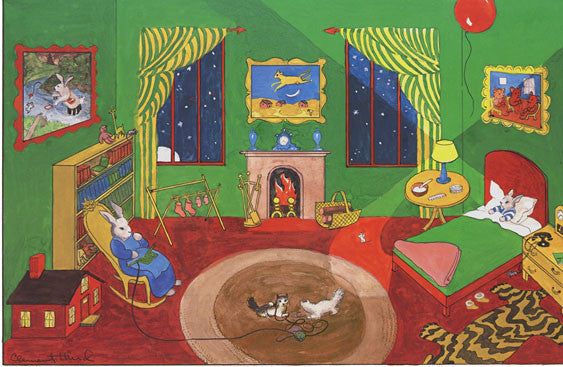
Image by Clement Hurd from Margaret Wise Brown’s Goodnight Moon
There's a ritual in our house, a nightly laying on
of hands. Kids come, teeth brushed, laptops stowed,
to our bed. They're bigger these days, stretching
the length of our own bodies. Showering love owed

on the dog, a pure-breed full-grown runt: Buddy.
Underdeveloped tear ducts stain his fur deep
brown, damp symmetrical tracks from
eyes to snout. He accepts the love, from kids sleep-

ily giddy. They push aside his squeaky toy &
the gnawed rawhide, its meaty marrow drained hours
or days ago. They lie down nose to nose with him,
holding his head in their hands, fully calmly ours.

When younger, they lay down hoping to stay the night,
spooning against his back, draping an arm
over his neck, their shared breaths a warm gentle metronome
marking the slow rhythm of a dying day, far

from the solitary beds where they belong. They
lingered; we let them, way back then, for a time. A family
at rest, warming the same bed. Pushing tomorrow
further away, drawing closer as one, sleepily,

to the symbol, the mascot, the blessed
embodiment of who we are, of how we love.
Many students will never write for fun again, will never choose to read a poem again, will never [sigh] read a book if they don’t have to. This time, this concentrated time, this shared & free thinking is all too often fleeting. They’re eager–most of them–to leave by the end of it all, they’re eager–many of them–to leave it all behind. They know what they’ll be leaving behind, and they won’t much care.
And I will not care that they won’t much care because I know that this carelessness too is fleeting. Rooted in even the most careless, when they think of it at all, is some respect for my respect for our work, for our words together. And at some future reception, they’ll tell me, unprompted, “You know, I still have that book”.
A book they’ve held over & over again, that they’ve packed up & moved, that they’ve unboxed & put on a shelf, that they’ve preserved for years, maybe that they’ll hold & carry, store & stare at (even if unopened) for their entire lives.
To them a symbol, to me a record, of their once-deep thinking, their once- and maybe still-widened mind.
Inspired by my discovery somehow of this word–se·rot·i·noussə-ˈrät-nəs : remaining closed on the tree with seed dissemination delayed or occurring gradually
You celebrate the first steps
which look like what they are,
a controlled fall. Eyes wide
in joy, in disbelief.

The steps grow varied
in pace in path in purpose.
You're often alone, doing your best
to keep moving somewhere somehow.

Eventually you walk without thinking,
your horizons & paths narrowed--
appointments not destinations.
In rare moments, your eyes open,
your feet fly, knowing nothing
can hurt you till you stand still.
The doors are heavy, falling shut with a slow ease & finality. The space is sacred to some, to those who work it, to those who hope to cast the spell.
Every theater has its own relic’d beauty–loose hinges on the front & center seats, faded fluorescent tape marking the limits of characters long silent, scarred lines marking the props dragged season after season.
The heights are seen only by the lucky. Sandbags & catwalks, lights & innumerable cords. Rows of scrims, depths of story, layers of place.
You get on stage with the rest of this unkempt bunch, untied Converse shoes & loose t-shirts. You shake the tension from your shoulders & join hands, centering yourself in this song & dance, this ceremony seen only by the lucky, performed only by this loving few.
Let us play.
Thanks to Ruben Quesada for the guidance during a workshop in July 2022, when I wrote a lot, including this draft, when he challenged us to capture a time of joy.
Tell yourself as it gets cold & gray
that it is going to pay off.
The planning & grading,
the commenting & designing,
the paperwork & meetings. For you
there's the chance to reset over & over.
New units, new semesters,
new years, new courses,
December punctuated loudly
with good news from seniors,
a future they hoped & worked for,
acceptance, relief.

Tonight as it gets cold,
count the days, and know
that there is never enough time and
that there is always just enough time.
It resolved, or it didn't
in ways you'll never know.
They learned & they struggled
in ways you'll never know.
And you'll start it all again
sooner than you can imagine.

And if it happens that you cannot
reconcile yourself to this necessary
end, this final weeks, then delight
in the joy of your students, for whom--
in the best possible ways--
you were just another adult
standing in the current of their lives,
guiding them, and telling them,
Good morning. Good job. Goodbye.





 middleagedmiddlechild.