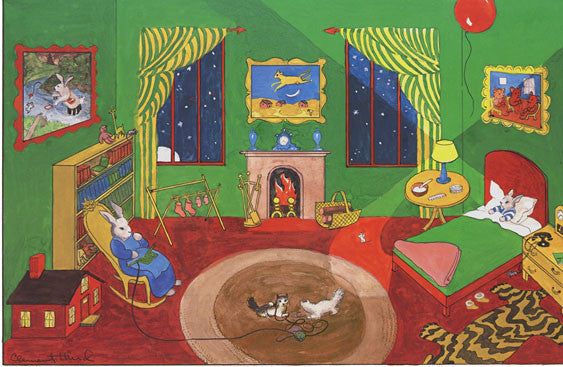
Image by Clement Hurd from Margaret Wise Brown’s Goodnight Moon
There's a ritual in our house, a nightly laying on of hands. Kids come, teeth brushed, laptops stowed, to our bed. They're bigger these days, stretching the length of our own bodies. Showering love owed
on the dog, a pure-breed full-grown runt: Buddy. Underdeveloped tear ducts stain his fur deep brown, damp symmetrical tracks from eyes to snout. He accepts the love, from kids sleep-
ily giddy. They push aside his squeaky toy & the gnawed rawhide, its meaty marrow drained hours or days ago. They lie down nose to nose with him, holding his head in their hands, fully calmly ours.
When younger, they lay down hoping to stay the night, spooning against his back, draping an arm over his neck, their shared breaths a warm gentle metronome marking the slow rhythm of a dying day, far
from the solitary beds where they belong. They lingered; we let them, way back then, for a time. A family at rest, warming the same bed. Pushing tomorrow further away, drawing closer as one, sleepily,
to the symbol, the mascot, the blessed embodiment of who we are, of how we love.
Many students will never write for fun again, will never choose to read a poem again, will never [sigh] read a book if they don’t have to. This time, this concentrated time, this shared & free thinking is all too often fleeting. They’re eager–most of them–to leave by the end of it all, they’re eager–many of them–to leave it all behind. They know what they’ll be leaving behind, and they won’t much care.
And I will not care that they won’t much care because I know that this carelessness too is fleeting. Rooted in even the most careless, when they think of it at all, is some respect for my respect for our work, for our words together. And at some future reception, they’ll tell me, unprompted, “You know, I still have that book”.
A book they’ve held over & over again, that they’ve packed up & moved, that they’ve unboxed & put on a shelf, that they’ve preserved for years, maybe that they’ll hold & carry, store & stare at (even if unopened) for their entire lives.
To them a symbol, to me a record, of their once-deep thinking, their once- and maybe still-widened mind.
Inspired by my discovery somehow of this word–se·rot·i·noussə-ˈrät-nəs : remaining closed on the tree with seed dissemination delayed or occurring gradually
You celebrate the first steps which look like what they are, a controlled fall. Eyes wide in joy, in disbelief.
The steps grow varied in pace in path in purpose. You're often alone, doing your best to keep moving somewhere somehow.
Eventually you walk without thinking, your horizons & paths narrowed-- appointments not destinations. In rare moments, your eyes open, your feet fly, knowing nothing can hurt you till you stand still.
The doors are heavy, falling shut with a slow ease & finality. The space is sacred to some, to those who work it, to those who hope to cast the spell.
Every theater has its own relic’d beauty–loose hinges on the front & center seats, faded fluorescent tape marking the limits of characters long silent, scarred lines marking the props dragged season after season.
The heights are seen only by the lucky. Sandbags & catwalks, lights & innumerable cords. Rows of scrims, depths of story, layers of place.
You get on stage with the rest of this unkempt bunch, untied Converse shoes & loose t-shirts. You shake the tension from your shoulders & join hands, centering yourself in this song & dance, this ceremony seen only by the lucky, performed only by this loving few.
Let us play.
Thanks to Ruben Quesada for the guidance during a workshop in July 2022, when I wrote a lot, including this draft, when he challenged us to capture a time of joy.
Tell yourself as it gets cold & gray
that it is going to pay off.
The planning & grading,
the commenting & designing,
the paperwork & meetings. For you
there's the chance to reset over & over.
New units, new semesters,
new years, new courses,
December punctuated loudly
with good news from seniors,
a future they hoped & worked for,
acceptance, relief.
Tonight as it gets cold,
count the days, and know
that there is never enough time and
that there is always just enough time.
It resolved, or it didn't
in ways you'll never know.
They learned & they struggled
in ways you'll never know.
And you'll start it all again
sooner than you can imagine.
And if it happens that you cannot
reconcile yourself to this necessary
end, this final weeks, then delight
in the joy of your students, for whom--
in the best possible ways--
you were just another adult
standing in the current of their lives,
guiding them, and telling them,
Good morning. Good job. Goodbye.
She had high hopes for a tree that flowered. So many in this neighborhood were planted for another place, dense canopies you might see in a movie or in some part of town richer & older.
She hired an arborist, a kind & fussy man who called each tree by its Latin genus name, who spoke surprisingly good Spanish to his crew scurrying high above, chainsaws swinging heavily from their loose belts.
They removed the old tree, its spiky circular spores tucked in the grass for years after. She watched as they lifted the new tree from the bed of the truck, a canvas bag diapering its thin roots.
They drove spikes into the earth surrounding the hole, upturned & fragrant. The roots of the old tree were left to wither in the unseen deep. She imagined the burst of color to come.
The tree grew & flowered, less bright than she had hoped. A freak cold snap historic & long chilled the tree to the core. Her husband watched it for weeks, certain something could be saved.
Different men were hired to make rough cuts, feeding the fallen branches into a machine at the curb, mulching them briskly right before their eyes, dust catching in the brittle grey grass.
It grew the next year thick with leaves near the trunk. Branches will come anew, they thought, will come later.
It flowered as before. It flowers each year, waving gently in the piercing Texas sun.
“I think everyone should be able to pick a word that moves them, and occupy it” (Eileen Myles, in the afterword to this anthology)
My word came to me late, in a language I don’t know. I can’t write it, and I do a poor job saying it: רוּחַ. Ruach, that is, spirit, unless it means wind, or unless it means breath, or unless it means something else.
I’d like to be that רוּחַ heard before it’s felt, almost never seen, energized & untroubled by obstacles. Even those windbreaks I’ve seen (straight, high in their fields) are flat & small in the full force of a vast & powerful רוּחַ.
I’d like to be that רוּחַ that swells & enlivens each living being. Enriching the blood imperceptively, autonomically, feeding each cell from head to tail, then disappearing, returning seconds later all life long.
I’d like to be that bold רוּחַ I once was, alive in the spirit. G-d moves within me, I’m certain, though it’s been a while since I occupied the spirit, since I prayed with that presence, since I prayed for that presence, since I prayed. The spirit calls often & in ways unimaginable. Let all who hear it come, let those who are thirsty come drink the רוּחַ like water, drink it without pride.
This varied earliest holy רוּחַ … the word came to me long after I’d felt it, long after I’d embodied it, long after it had blessed me. The idea, the promise, the gift of רוּחַ has always been here. Bringing natural beauty nearer, filling my chest, nourishing the smallest most intimate parts of me, blessing & keeping me.
We were lined up by height, walking somberly to the altar, pews filled with proud parents.
Back then Granny couldn’t afford much, but she got me an Avon Batman brush as a gift.
I was at home here. Praying, singing, kneeling, and being filled with the spirit.
In the photo of our class that day, I am toothless, looking off camera. I know I was happy.
Back then Granny couldn’t afford much, but she got me an Avon Batman brush as a gift.
I imagine now the Avon lady coming to her door, Granny sitting by the room unit, looking over the catalogue page by page.
In the photo of our class that day, I am toothless, looking off camera. I know I was happy.
Years later, we found out what the priest had done to that community, to those kids.
I imagine now the Avon lady coming to her door, Granny sitting by the room unit, looking over the catalogue page by page.
What do you get a child? What do you get this child? What will his parents think?
Years later, we found out what the priest had done to that community, to those kids.
The parents, horrified in their blind trust. The newspapers laying bare the worst.
What do you get a child? What do you get this child? What will his parents think?
The trial stretched out. We knew the name of the priest--the children’s names, only whispered guesses.
The parents, horrified in their blind trust. The newspapers laying bare the worst.
And one lingering memory: A priest doing chin-ups on the blacktop, children beneath him, counting.
The trial stretched out. We knew the name of the priest--the children’s names, only whispered guesses.
We moved to the church across town. It was the first of several moves my parents made on principle.
And one lingering memory: A priest doing chin-ups on the blacktop, children beneath him, counting.
And a memory my mother shared only recently: Shouting at the pastor in the rectory, slamming the door.
We moved to the church across town. It was the first of several moves my parents made on principle.
An unnecessarily partisan homily here, an unwelcoming community there. Where is the life of the spirit?
And a memory my mother shared only recently: Shouting at the pastor in the rectory, slamming the door.
These cloistered virgins were in over their heads. I almost pity them. I tried to love them.
An unnecessarily partisan homily here, an unwelcoming community there. Where is the life of the spirit?
My parents, hungry for the body of Christ, made a home that seems now like an answered prayer.
These cloistered virgins were in over their heads. I almost pity them. I tried to love them.
What could they know about the faithful? Didn’t they know this passing stop for them was home for us?
My parents, hungry for the body of Christ, made a home that seems now like an answered prayer.
Where two or three are gathered together in His name, G-d is there. You felt it. You knew it.
What could they know about the faithful? Didn’t they know this passing stop for them was home for us?
Some have married. Some have died. Some moved on. Two that blessed me then are now in prison.
These days I walk down the aisle rarely. But I still believe. And I pray that I go in peace to love & serve.
This is my first pantoum ever, a kind of return to this moment. The title is from Psalm 34:8.