You wear a white shirt,
grey slacks, and a plaid tie.
A uniform of academic
seriousness & middle class.

You roll your sleeves up
& unbutton your shirt
at the neck. You feel there's little
on the surface you choose.

You are freest on your paper route,
especially Sunday mornings
weaving slowly from curb to curb,
crossing the double yellow line.

All four lanes yours.
The city asleep.

Inspired by Erika L. Sánchez's "The Poet at Fifteen", which was inspired by Larry Levis's "The Poet at Seventeen".
I recently read a book that was part investigative journalism, part literary criticism, part feminist meditation, and part motherhood memoir. Now I’ve read another one.
I’m glad that I was not familiar with the story of Marguerite de la Rocque, otherwise I might have been frustrated by how often the author centers herself, or how often she calls previous evidence in the question. This herky jerky style and approach turns out to be the one that mirrors the action of writing, and wondering, and drafting better than any “straight” history or memoir could have. Surprises land hard, both personal and academic; blessings abound (just the right library recommended to find just the right centuries-old map).
Ramqvist has several challenges in the telling. She must navigate the paths taken by three previous authors who have told their versions of the story, sometimes centuries earlier, and thus, sometimes restricted by personal connection to Marguerite, by connection to the uncle that banished her, by connection to centuries-old ideas of propriety & euphemism. She also cannot help but read her current self through the lenses of her selves — as a mother, as a Swede, as a once-young woman making risky choices with dangerous men.
What was most pleasurable about the book turned out to be this personal reading of the self. Her travels & frustrations with her teenage daughter reveal a lot about the blessings Marguerite lost as a mother, a lot about Ramqvist’s own understandings of independence and adventure, a lot about how we read the rare stories extant of famous women from centuries ago.
There is a tree at the heart
of our house. A live oak
reaching up in three directions,
waist-thick master branches
rough & mossy.
I imagined it as mine
the moment I saw it.
The house would belong to all.
The tree to me.

From beneath it, I can see
into each room. I don't look up
often enough. I look around,
from window to window,
at my family, my house
alive & secure. A life-size diorama
I'm growing old in.

Every few years the tree gets trimmed,
sometimes as much as a third of it
gets sawn off, mulched, & driven away.
The dust settles bright & aromatic,
a sandy pattern within
the ridges of the roots.
The canopy lifted,
the shade dappled anew.

And my tree bounces back,
quickly dense again with leaves,
stretching up imperceptibly,
inch by delicate inch over
the chimney, over me.
I sit, book & wine at hand.
Breathing deep & waiting
to be called back inside,
back home.
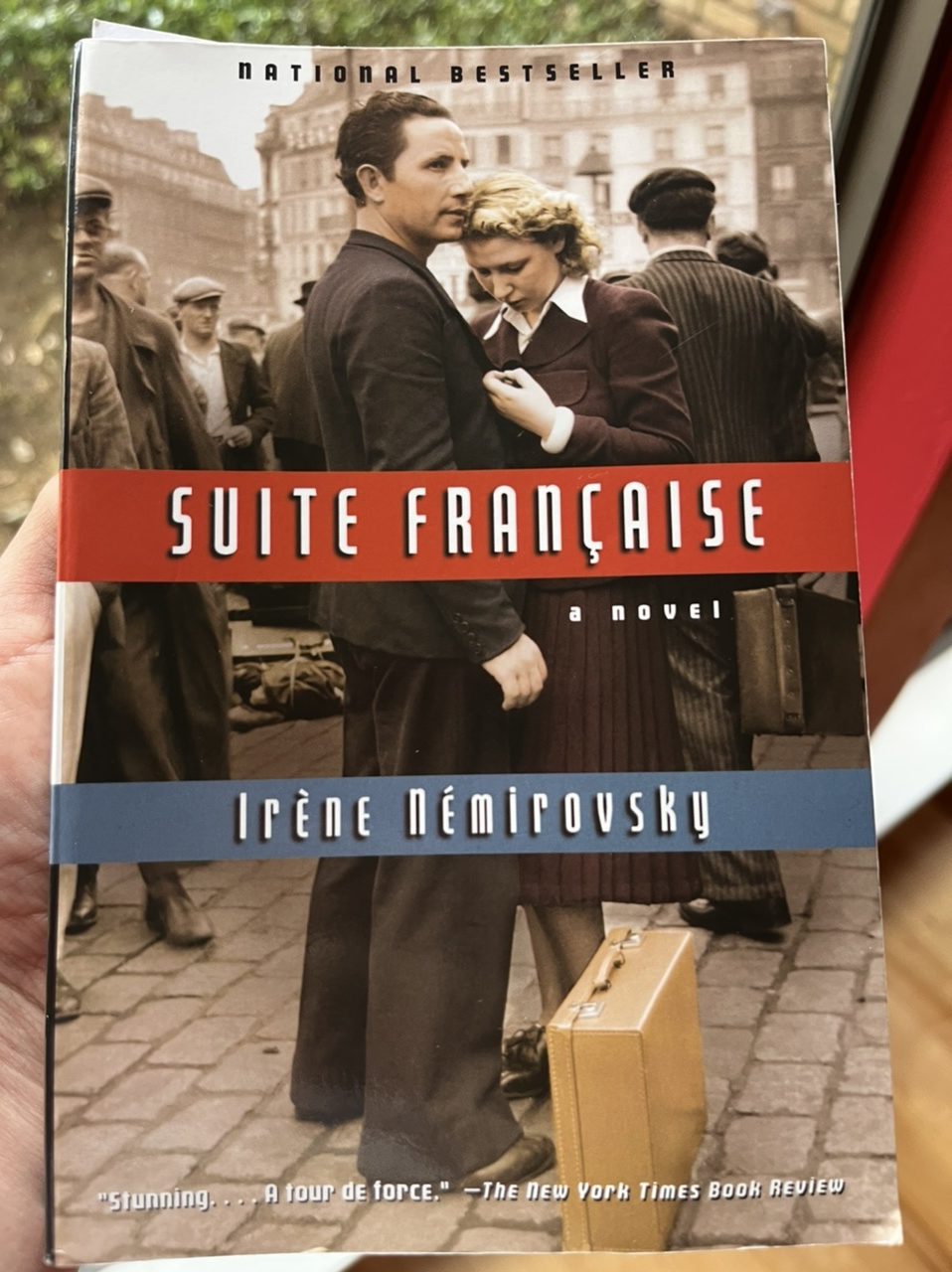
I’ve seen Irene Nemirovsky’s Suite Française popping up on my Twitter feed for a long time. The colorized cover photo, which originally I thought was a little sentimental, turns out to be precise & appropriate. Though it’s got a cast of dozens, the heart of the novel is the drama of a man & a woman in a time we think we know well (WWII). The photo shows a man & woman of a certain age … no longer young, but still full of vigor & life & possibility, and in this case, full of uncertainty. They’re united but looking in different directions; I’d say that they’re in an embrace, except for the fact that each of them has a hand free.
It’s that kind of novel. One of uncertainties during a time of turmoil in Europe, here, in occupied France in 1940 & 1941. Nemirovsky, a Jewish novelist living in Paris, begins Suite Française with a kaleidoscopic energy. The Germans have moved from air bombing France and are marching on it, swiftly and successfully.
The opening part of the two-part novel focuses on several different families & citizens fleeing Paris with what little they have, with what little they can not bear to leave behind. Their fates are as varied and as shocking as … well, the fates of refugees in a time of war. Nemirovsky makes these continental events domestic & interpersonal — the wounds & kindnesses, the good luck & the bad fortune. The struggle for shelter & bread, for petrol & a shave.
The second part of the two-part novel focuses on a single occupied village, tracking the uneasy routines that emerge over months. Soldiers billeted in private homes; French officials compelled to (& enjoying the safety) of collaborating with the occupying German forces; children & survivors of the Great War dazzled openly & quietly (respectively) by the precision & strength of the Germans. And finally the women, performing obedience and politeness, while meditating in interior monologues about the beauty and natural novelty of young men in the village — their village’s men having left for war months and months earlier. Nemirovsky centers the drama of part two on the newlywed Bruno (a German officer skilled at music and eager to make the occupation civilized) and the newlywed Lucile (a girl from the forests waiting for a husband that doesn’t love her to return, enamored with the walks & talks, the talent & promise of Bruno).
Nemirovsky meant for this to be a five-part series. She was arrested in 1942 “and deported to Auschwitz, where she died. For sixty-four years, this novel remained hidden and unknown.” As a result, the novel ends with an unintended verisimilitude — none of the characters know and the author cannot hint at what is in store for these characters, for their way of life on part two’s last pages, set in July 1942 as the Germans leave the village for the Russian front.
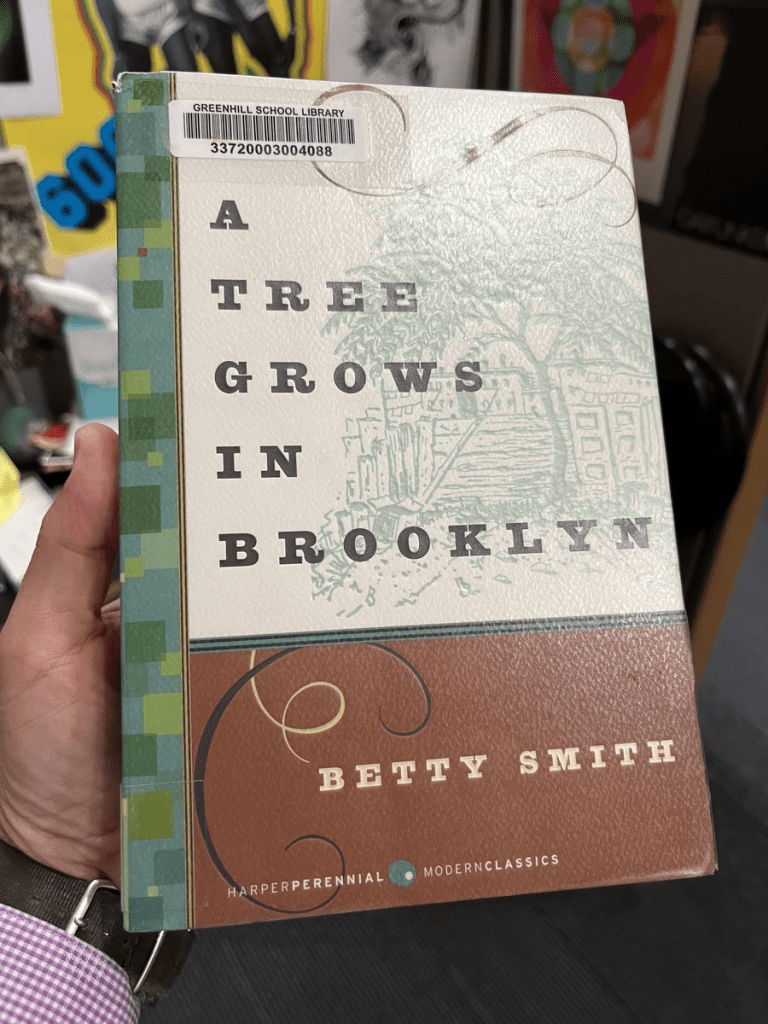
I have heard great things about Betty Smith’s autobiographical A Tree Grows in Brooklyn all my life—the book and the movie. I finally got around to this readable, accessible, emotionally & historically nimble story.
To say that it’s a coming of age story is accurate, to a point, as accurate as it is to say that it’s a family story or a bootstraps story or a … well, we’d call it historical fiction now, but it was written originally with the psychological & emotional precision that the best stories have.
Betty Smith shapes the protagonist Francie & her family through the lens of what Toni Morrison once called Homeric fairness. That is, it is a story told bravely & honestly, a growing up ennobled & complicated by surprising empathy & honesty. Francie endures the fact that she is less loved by her mother than her brother is — but Smith depicts the mother chides her disarmingly to the effect of, “Oh, honey, don’t make a fuss — you know that he needs my love & support more than you do.” And you believe the mother. Francie bristles at the indignities & consequences of her father’s drunkenness — but Smith also centers the father’s love & struggles, his talent & tragedy.
I could go on. There’s no single antagonist, no enemy (unless it is poverty). There is instead the ambiguities of life & the everyday heroism of love & hard work, the gentle daily blessings that get people through the persistent daily burdens & losses.
It is a beautiful & hopeful book, made all the more beautiful by the direct style (which has moving flourishes & shifts in POV) and made all the more hopeful by the realization that we are not alone, or at least not alone for long.
Three Chimneys parking lot, Greenhill School, April 27,2022
Every few summers
right before the kids return,
the cones & ropes come out
directing traffic somewhere else.

There's a potbellied trailer
spattered & smoking, surrounded
by men in fluorescent vests
& tarred steel toed boots.

The asphalt goes down
thick & clean, the oily heat
rainbowing & distorting
the new view.

Then a slower process,
stencils & block letters,
striping & labeling:
students & faculty,

visitors & diagonally reserved spots
we hope never to need,
a reminder of the everyday horrors
that happen somewhere else.
Years later the colors return
to the earth, as we all must.
Cracked & bubbled, a broad mottled stripe
thrown into relief by sun & time.

The lines, faded & crumbling,
can still keep us safe.
We remember
where we belong.
On April 27, I sent my students outside with their phones to return with photos of different colors. This is inspired by a color I found.
Along with the usual noises
(washing machines, wind chimes),
this house has other voices.
Scratches, creaks, murmurs, all times,
all corners of the house. Like a
conductor tapping a baton,
a critter's feet ticks out a
path across the roof, lighting upon
the shingles faintly. Beneath
the deck, deep in the shrubs,
a bit of digital-ish noise beeps
& chirps, then drops out, an abrupt
small wild world alive, persistent -- but each
time I approach, silent, just out of reach.
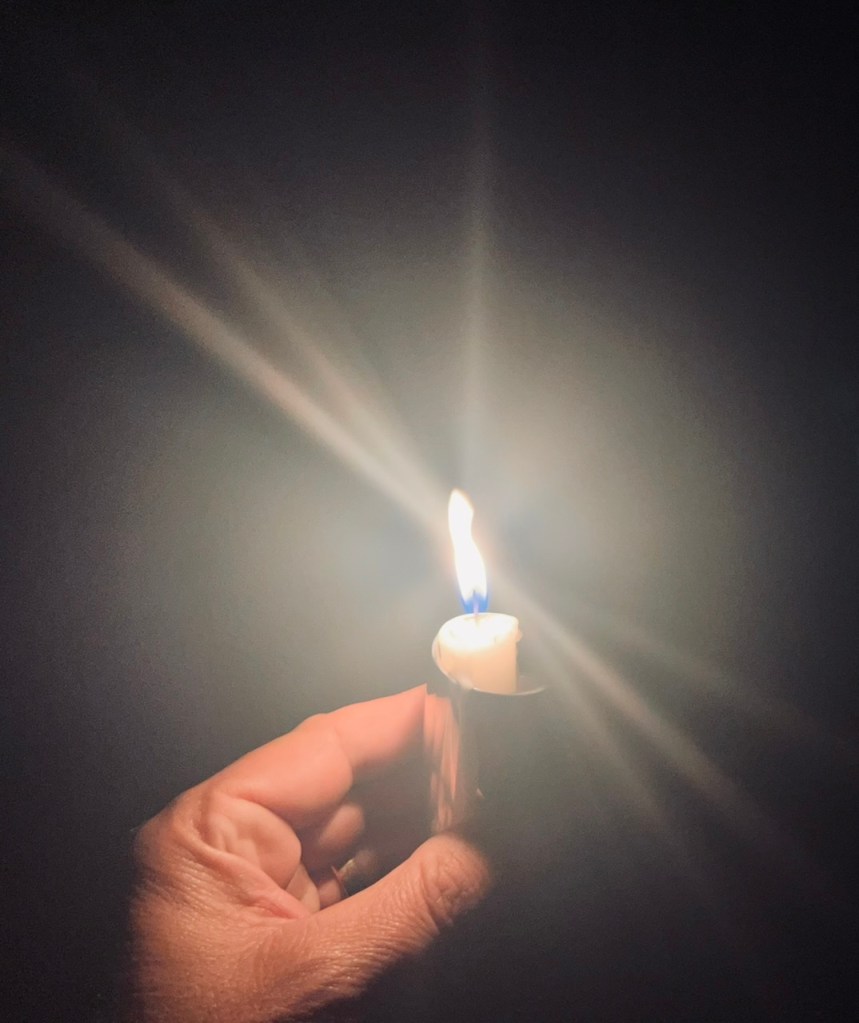
which is to say
in the darkest of hours
there's a flickering,
an easily snuffed light.

You can lift it,
you can move it,
but you must
protect it.

A hope chest holds
soft elegance,
handstitched care
for the body & the bed.

A hope candle can last
if you're careful & still.
Keep it close.
Keep it dry.

Watch hope dance then stand
to reveal dangers, to ennoble
wide eyes. Windowed, mirrored,
it even grows.

Hope throws big shadows,
darkening what's behind.
So look ahead, look close.
And hold your breath.
The light comes before 	the rumble.
The longer the gap		between them,
the further the storm		from you.

The first flash woke me.	For once,
my wife slept through	it all.

I lay alone with the sound	        and light,
watching, listening, 		        and counting.

Light, 				one Mississippi,
two Mississippi,		then

a rumbling menace 		                           above the roof.
Windows rattled, the dog	burrowing        between us.

In the next flash, 		a silhouette, a child
midstride, framed by		the illumined window.

He climbed through		        the thunder
into the flannel & heat		a safe dry place
between father, mother,	        and dog.

The sound got as close		as the light.
It rained 		                        till morning.
There’s a rusty chair left over
from your grandparents in law,
one the squirrels haven’t yet
torn to shreds.

Pull it from the corner of the yard
and right to the center,
the pollen crunching
under your feet.

There’s a neighbor behind you,
his garage door open.
Music is playing. Something is
being fixed or installed.

Push that from your focus,
and avoid being annoyed
by his perpetual busy
suburban nesting.

There’s a deck before you,
decades old, creaking & buckled
from rain & sun,
boards warped & bleached,
nails reaching upward.
Some slats mossed over
fold beneath the lightest
of footsteps.

Give thanks for the long years
this space has given you,
and avoid being annoyed
at this crumbling hazard.

There’s a vista before you,
a roof that’s never leaked,
a tree above it, right at the center
of this part of your life.

Cross your legs. Palm the glass
of wine. Watch for mosquitos.
And look up.

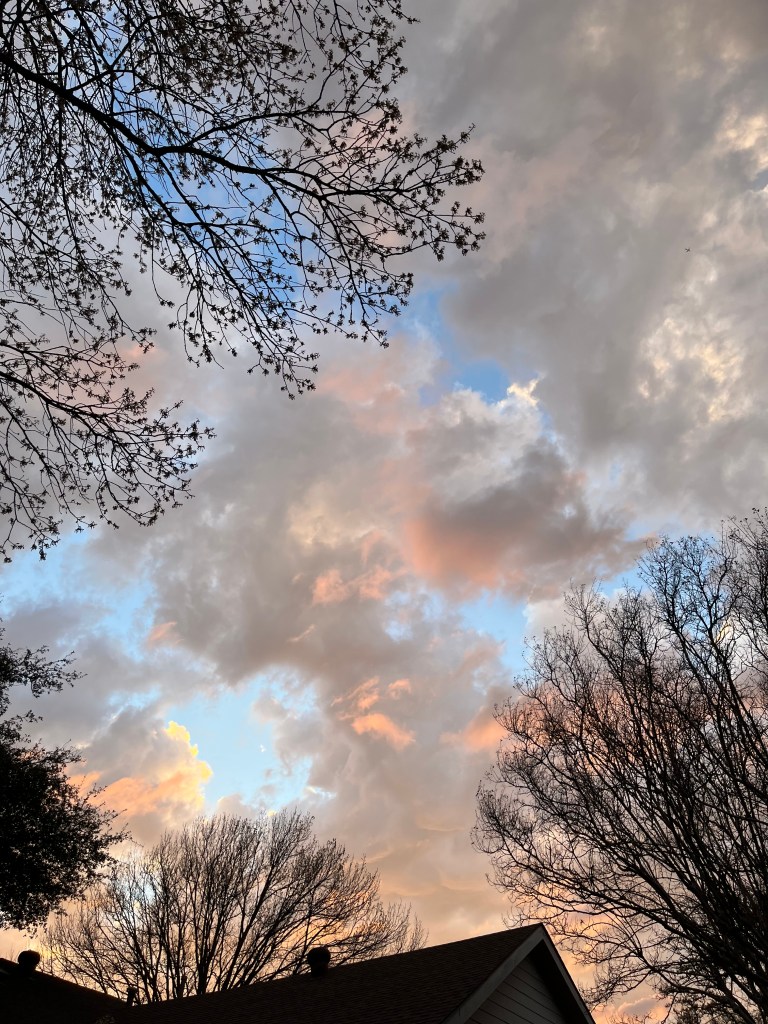
There are clouds & birds,
branches & wind.

It’s all starting again.
It always will.





 middleagedmiddlechild.