For four years, I tracked my reading, and as a result, I got to the point where it’s kind of a habit that I read broadly ([ahem] at least within literary fiction), that I read as much as possible in translation, and that I am deliberate about what I read next.
It’s been a while since I read R.F. Kuang’s Babel which I recommend enthusiastically. To aim to write a smart, accessible, thoughtful, & suspenseful novel is quite a narrow target to hit, and that one definitely did. Ada Limon’s The Hurting Kind is similarly smart & accessible, with a really gentle seasonal organization that never feels like it limits the poems. I reread Peter Carey’s True History of the Kelly Gang, which is an engrossing story about a man pushed too far and the lengths he’ll go to set the story straight (even if it’s not entirely factual). But this post is about a chunk of reading that’s a little more deliberate, a set of books that I hoped would get outside of myself.
Usna Aslam Khan’s The Miraculous True History of Nomi Ali is a historical novel about a place I’ve never even heard of–the Andaman Islands. Leave it to an independent press (Dallas’s Deep Vellum) to take a chance on a novel like this one, that deserves a wide readership and will challenge anyone that picks it up. Khan’s Nomi of the title is not the main character, nor is she explicitly any more of a witness or a survivor than her brother Zee (who suffers a terrible fate due to a single courageous act) or her father (bent low, literally, by his punishment for a crime he committed, which brought him to the islands) or her mother (who suffers losses that eventually become unspeakable). Khan makes the reader feel deeply about almost every character, no mean feat, given that some of the colonial administrators are complicit in, at best, cruel & unusual punishment. This might fit under historical fiction or post-colonial literature, and in ways that test the limits of each genre. It is a novel in which the bravest act of all is staying put and trying to find the beauty & the humanity around you.
I’ll update this post when I finish Rodaan Al Galidi’s light-hearted (or is that deep-heared?) refugee novel The Leash & the Ball, Melody Razak’s debut about 1947’s Partition Moth, Ingrid Rojas Monteras’s memoir about a journey into her family’s history in Colombia The Man Who Could Move Clouds
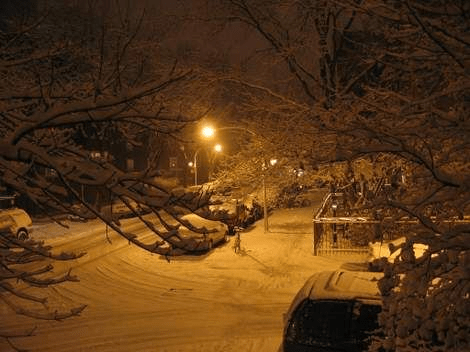
The wind was blowing most of my first day in town, and the snow flakes fell gently, slowly, cartwheeling to me with cartoonish clarity, like a confetti’d welcome for us alone. We were two blocks from a good bar, a decent diner, a video store, and an El stop. We were in love.
She had chosen our home well–not the hippest neighborhood but still one that felt like a city I’d never known, like a place where the rest of my [ahem] … where the rest of our life together would begin.
Instead it was an extended break, not quite vacation not quite holding pattern. I continued teaching but not well. She found a job at company called Oracle. My wife looked her up. (I was curious too.) Apparently, she still works there. She set down roots; I did too, somewhere else.
The wind blows there even now as strong as ever. I saw it on TV the other day. It looks just the same as it did that January.
The image is from Andrew Sullivan’s View From Your Window feature. I saved it as “ChicagoIL930pm” but cannot find the original source or photographer.
You create an account gently, and you construct
a password--a nonsense mixture made memorable,
letters, numbers, characters made special
somehow, a song lyric, a sentence you alone know.

You pull the doc from the drive, a last look
at a once-inspired miracle, a polished
inert version of the original spark, now rendered
regular, out of your hand & into gently.

Gently receives the doc, a new screen
assuring you that the server worked.

You forget and wait, gently. Gently managing
the impersonal viewable shareable
version of you at your most artful,
most vulnerable, most hopeful.

Three weeks later, gently a message
in your inbox.

No.
Thank you.
Sincerely,
Gently.

This is inspired by Sophia Terazawa, who gave my class the following writing prompt: Personify an adverb. I chose to personify the writing submission platform Submittable as the adverb "Gently". So above every time I originally referred to the platform, I substituted the word Gently.
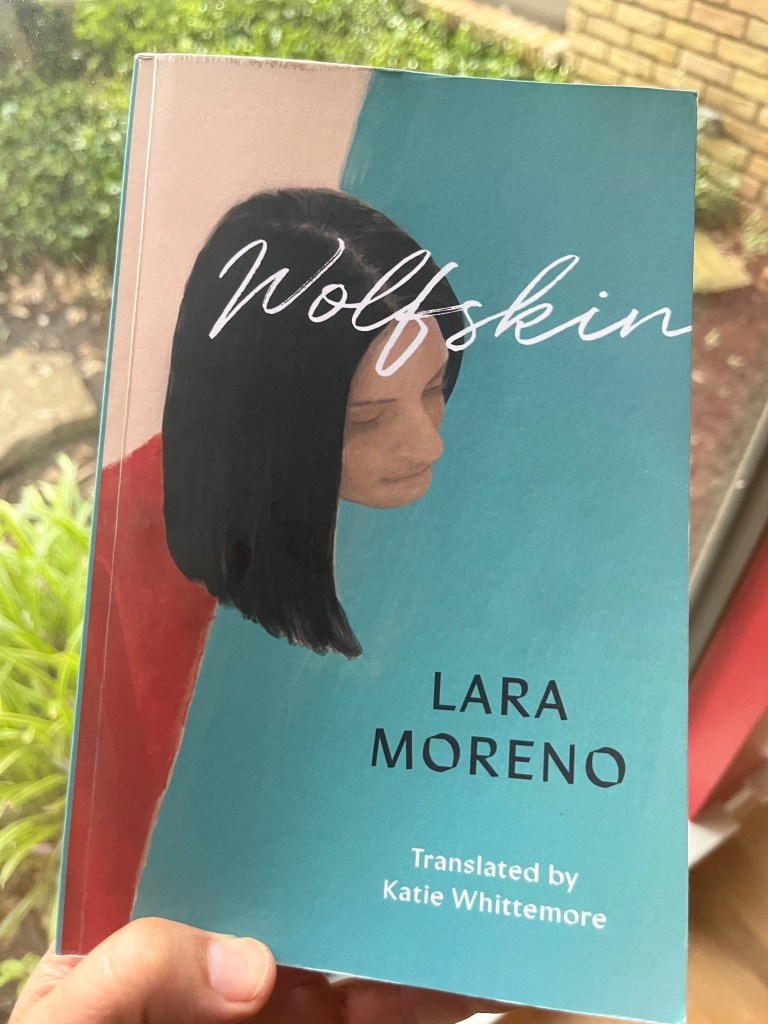
At some point months ago, I signed up for (and then forgot about) Open Letter Publishing’s Translator Triptych Bundle, which got me three Open Letter books written by Spanish female authors and translated by Katie Whittemore. I wrote about Mothers Don’t already. And I just finished Lara Moreno’s Wolfskin.
Like Mothers Don’t, this one focuses boldly on the interior lives of a mother, and the non-mother parts of that person, the parts that strain against the expectations of motherhood.
In Moreno’s novel, the everyday strain of being an independent fully formed person and a mother is exacerbated by a surprise—the protagonist Sofia is blindsided by her husband Julio’s wish for a divorce. “Wish” is not abrupt a word–more like “steps toward getting” a divorce. She thinks nothing of their regular marital spats or disagreements, and she thinks nothing when his toothbrush is missing one morning. When the conversation eventually happens, there’s little to discuss: He will leave their apartment, he will support her, and he has it all figured out—even with an apartment at the ready. Sofia, he assumes (correctly), need take care of their son Leo as if nothing has happened. Julio will carry on as if what has happened is precisely what he wants, which it is. Moreno renders this emotional turmoil in very relatable & shrewd detail. Tears, worry, unanswered texts, accusations, siblings and parents drawn into the separation, all while Sofia struggles to keep things normal—until she chooses instead to retreat to her recently deceased father’s home for the summer. That’s the opening thirty pages or so.
With this escape Moreno complicates our sense of what a good mother is, what an amicable separation should look like, what sibling support looks like, what stops and what continues when the disruption in our lives does not approach in sheep’s clothing, but instead when we realize that we let the wolf in willingly, we saw his skin all along.
I’d give away everything if I wrote more. Just know that Whittemore manages Moreno’s prose & the characters’ voices deftly, including shifting perspectives & timelines, as well as the sentences that unspool for a page or more when the emotions become … well, when it’s appropriate. Know it’s also a novel about sex, about trauma, about sisters, about innocence, about letting people in. Highly recommend for mature readers.
For four years, I tracked my reading pretty carefully. It was a worthwhile project for four years, but the user interface there got unwieldy. Now I post readings here. I’m proud that these four most recent books are all literature in translation. Four years ago, that kind of flurry of translated lit would have been planned, would have been a choice. Now, it’s a habit.
Since I teach a lot of students of Indian heritage, I had my antennae up for Indian authors. Two short story anthologies really hit the spot.
Dallas’s own Deep Vellum Publishing published The Shehnai Virtuoso, a collection stories by Dhumketu, translated from Gujarati and compiled by Jenny Bhatt. Compiled from his twenty-four collections, this anthology offers a great variety — but for me a kind of single authorial ethos emerged. There is real affection for the characters, even those that make lousy choices, especially those that are in dire straits. There is an adeptness at setting and tone (realistic or fantastic, mythical then or megaurban now), and there is a satisfying wrap up to each. Generally, good things happen to good people, and Dhumketu lets us know why.
Archipelago Books published The Dog of Tithwal, a collection of stories by Manto, translated from Urdu. These are darker and starker than Dhumketu’s. I’m not saying that it’s a fair or necessary comparison–I just happened to read these collections back to back, so forgive the apples to oranges comparisons. Manto’s cities are a little more unforgiving than Dhumketu’s, the relations between characters a little more selfish and amoral. The prose, as rendered in translations by Khalid Hasan and Muhammad Umar Memon, is direct. It reminded me often of the kind of mindset & prose that Sherwood Anderson called grotesque, that is, a set of stories about people who stick to their own truth and live with it during all their lives, but their truth turns to be faulty or even downright false.
New Directions recently published Yoko Tawada’s Scattered All Over the Earth, a novel I purchased because the cover looked really cool. It’s translated from the Japanese by Margaret Mitsutani, and in many ways it’s a novel about translation, about trying to connect, about moving beyond who we are to who we hope to become. There’s a fact of the world of the novel that was very compelling that isn’t explained much: Sea levels have risen so much that Japan no longer exists. It’s been so long that Japan hasn’t existed that Japanese speaking people, like one protagonist of the novel, cannot find their language fellows. The hook is for this character to speak her own language with someone who knows it. There are other translators and global wanderers, people looking for a language of love & family, gender & food, friendship & home. It’s the first in a planned trilogy, and it feels like it–the wrap up leaves you in true suspense.
Open Letters published Katixa Agirre’s Mothers Don’t this year, translated from Spanish by Katie Whittemore. The title is the beginning of a sentence: Mothers don’t kill. This novel is about a mother that does, who kills her two infant children. The narrator of the novel is a recently-successful novelist (of a political thriller about ETA) and a new mother (of a fourteen-month-old son) who follows the trial of the mother, a woman she had a passing acquaintance with in college. Like another book I read recently, Agirre’s book draws upon religion, mythology, anatomy, forensics, personal experience, family upbringing, socioeconomic mores, cultural norms, and more to bring this tragedy (crime? temporary insanity?) to life. Agirre is unflinchingly honest about what makes for a bad mother, and how difficult it is to be good in what one does and in what one fights against doing, in what one thinks and in what one tries to banish from thought.
I’m not sure I can convey the charms of Such a Fun Age better than Trevor Noah did when he interviewed author Kiley Reed. It’s a smart readable suspenseful and morally complex story about race and class, and the American dream of reinventing oneself, if not climbing financially and socially. Reid choreographs a tense & sometimes beautiful pas de deux between her two protagonists—Emira, Temple alumna uncertain of what her future should hold, months away from aging off her parents’ health care plan, and Alix Chamberlain, the Instagram-sorta famous girl boss who hires Emira to babysit her child. Black women have been caregivers for white families for years, end this relationship is front at times with a deep strain of racial history and mistrust. Especially when friends get involved, love triangles form, and things go viral.
Ada Calhoun’s Also A Poet: Frank O’Hara, My Father, and Me is getting some well-deserved raves & attention. Like a couple of books I’ve enjoyed recently, Also a Poet blends cultural history, literary criticism, and personal memoir. Calhoun begins by trying to complete the unfinished project of her father–a biography of Frank O’Hara, a writer known primarily today as a poet but who was referred to famously in his NYT obituary as an art critic and “also a poet”. Through the course of the project, Calhoun battles her frustrations with her father, his friends, his past, and the executor of O’Hara’s estate. For all the insight that daughter & father gain into O’Hara’s life & times, it’s no spoiler to say that the book ends up being more about Calhoun & her father (an art critic and also a poet) than about the original subject, namely, Frank O’Hara. What the reader gets, however, is a complex & painfully true account of the process of writing, as well as the process of acceptance–of our families, ourselves, our pasts.
Even though I can’t remember reading a book like Juniper & Thorn by Ava Reid, I feel like I’ve confronted this story before. And I mean that in the best way. It’s got magic & love, sisters quarreling & dads exerting unreasonable control. Marlinchen is the youngest of the X family—Undine, the eldest sister, can read the future in water reflections, Rosenrot, the middle daughter, can create just about any potion or cure from herbs. And they’ve all been kept to their home (the mother deceased long ago, naturally) for years. Reid opens the novel with a rare, and fateful, journey outside the family’s grounds, a trip to the opera, which introduces a love interest in the main dancer, and which summons the father’s deepest rage that they have gone out into the city, full of temptations & modern conveniences (electricity, for example) that is making their magic obsolete.
I’ve been trying to read nothing but female authors for the late spring & early summer. I only had one slip-up, but I’m glad I read that one too : )
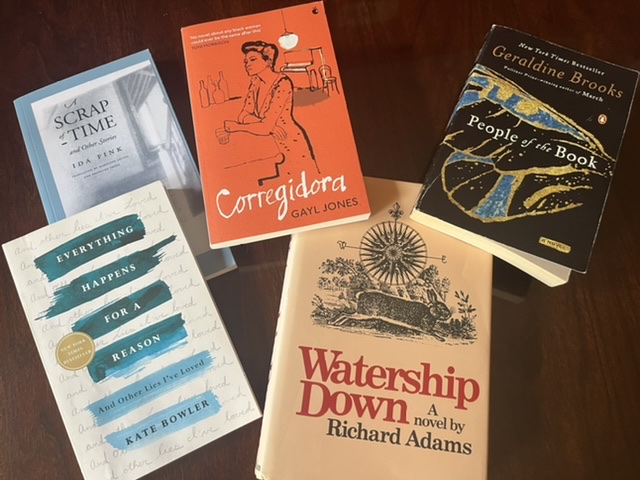
After Suite Francaise, I was looking for accounts of the daily realities of the Holocaust. Not camp memoirs or novels, not survival stories, but more stories like Nemirovsky’s that showed the way that towns & villages made possible the suffering of six million and more and their families. In that search I came across A Scrap of Time and Other Stories by Ida Fink. Originally written in Polish about Poland, A Scrap of Time is unforgiving in its … I was going to say in its slices of life, but it’s a collection that shows how cruelty and necessity slices through lives. The cast of characters is vast and believable, both those captured and those collaborating to liberate those hunted. Children, young women, the elderly, people alone, married couples, etc. There are moments of relief, but those are recounted in such a way that really had me reeling—was survival about luck? About personal bravery? Some cosmic tragic mix of both?
The blurb at the top of Gayl Jones’ Corregidora had me sold. Toni Morrison, Jones’ editor at one point, proclaims, “No novel about any Black woman could ever be the same after this.” The bar is certainly set high by this novel. It’s an unflinching look at the legacy of slavery & sexual violence, complete with wisdom of the ancients in Corregidora’s memory of her grandmother’s stories of enslavement. It’s a bold novel sexually, complete with frank and explicit depictions of loving intimacy and noncoerced submission. It’s written in a smoothly varied style that readers of Morrison & Hurston will appreciate, shifting effortlessly & powerfully between Black urban vernacular and modern stream of conscious prose and back again, often within the same paragraph. Finally, it’s driven by and complicated by Corregidora’s terrific freedom, in terms of her art, her friends, her family, and her career. A real stunner with a dizzying resolution.
Since I’ve read Dana Stevens’ criticism at Slate for years, I was really excited for her book Camera Man: Buster Keaton, the Dawn of Cinema, and the Invention of the Twentieth Century. It’s a biography as broad as the title. Stevens reconstructs every stage of Keaton’s career and the context surrounding it. The vaudeville stage and the advent of film that transforms / undoes vaudeville; the early days of film and the corporate consolidation of cinematic distribution and talent; the rollicking energy of Keaton in front of & behind the camera and the business errors he makes that compromise his financial stability; the cocktail parties of early Hollywood and the birth of AA; the meritocracy of the performing arts and the female directors, the Black artists that never got their due; Keaton’s struggles with alcohol and his success in his last marriage and as a gag writer for television stars. Like Elvis Costello’s memoir or Mark Harris’s Pictures at a Revolution, this book is gonna be one that you’ll want to read with a device nearby so that you can relive & re-laugh at Keaton’s timeless genius.
I remember hearing about Richard Adams’s Watership Down as a kid. Even then, it was spoken of in reverential terms, spoken of as a book that would move you & change you. It is, and it did. Like most adult readers, I’d say that it’s not really a kids’ book. I don’t doubt that kids will enjoy the suspenseful adventure / survival story—I know that I had a really difficult time putting the book down every night. And I hope that kids and / or suburban readers like me will take the time to follow along in the novel’s map, to look up topographical terms like … y’know, down or copse and botanical terms that show the plentitude of nature, even in a little corner of a little island. When readers like me say it’s not really a kids book, we really tell on ourselves. All great books are books of ideas. In this case, citizenship & power, nature & ingenuity, the self & the Other. One of my desert island books for sure.
I am a sucker for books about books. Geraldine Brooks’s People of the Bookwould count, I guess, as historical fiction. It is a fictionalized account of the Sarajevo Haggadah. A Haggadah is a book used during the Passover celebration to tell the story of the exodus & faith of the Jewish people; the Sarajevo Haggadah is, in history & in Brooks’s novel, a masterful work of art. The novel begins in the near-present with a manuscript conservationist hired to brave wartorn Sarajevo to work on the Haggadah. Brooks looks deep into the book—its fibers, its stains, its spine, its clasps—which take the reader back in history to see the inspiration & construction, the path & peril of this sacred text. The history is woven into the lives of the characters rather than inserted clunkily between their actions & journeys. The people of this book (in 1480s Seville, 1490s Terragona, 1600s Venice, 1940s Sarajevo) is distinct and deliberate in how they see & how they value the Haggadah. Highly recommend.
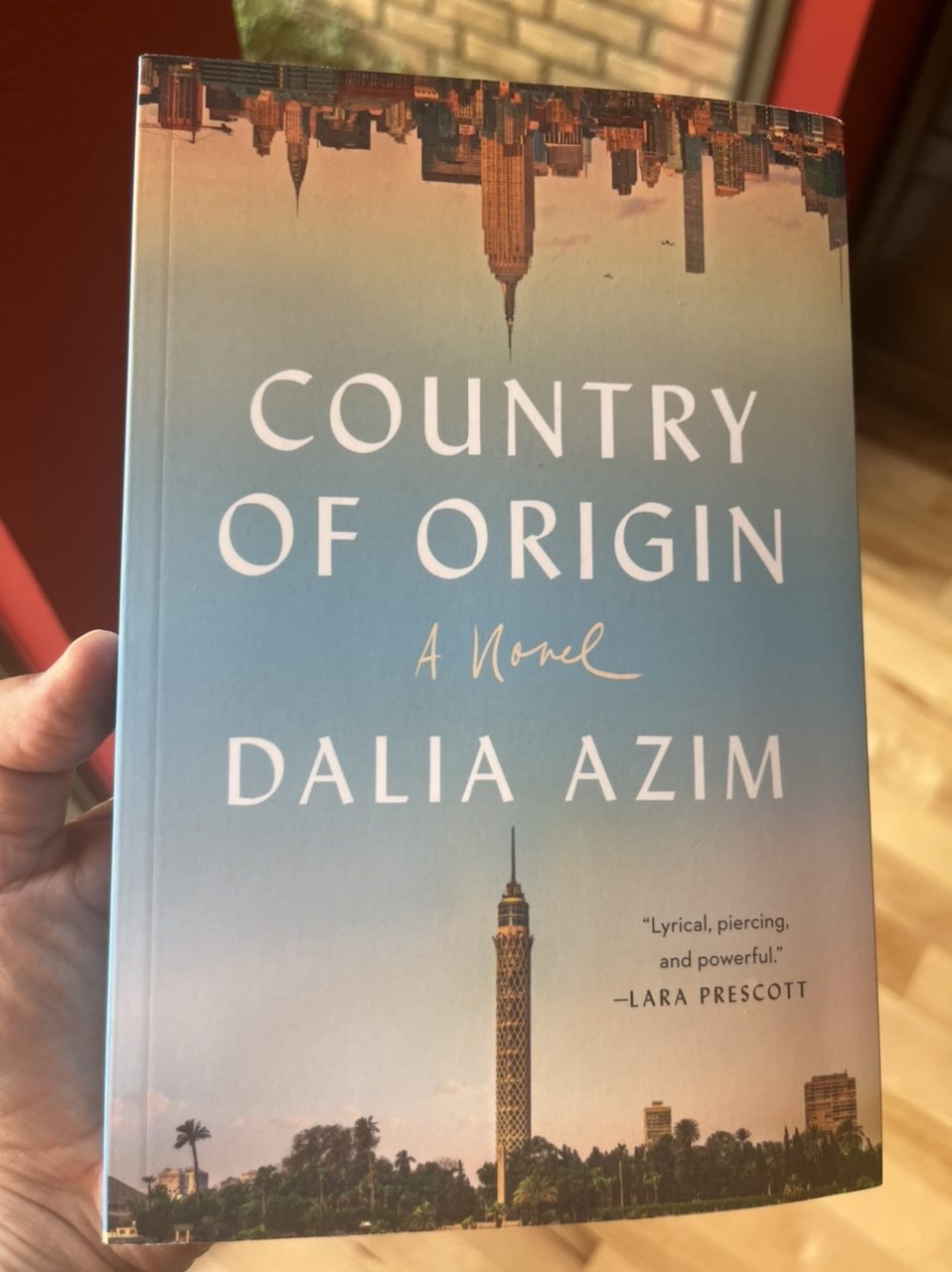
Over these past few years, we’ve had an embarrassment of riches with respect to cross-generational cross-cultural novels. Not all are immigration novels, but many are. Not all are trauma narratives, but many are. Not all are novels in translation, but many are. I’m sure you can think of many. Each time I read one of these important works, I’m humbled by the care with which the novelist crafts a difficult & deep personal truth. Dalia Azim’s Country of Origin is just such a novel.
Country of Origin begins and ends with women in transition, with women looking to the skies.
In the beginning of the novel (Cairo, 1951), a young woman looks to the skies from the roof of her comparatively luxurious, comparatively safe family home. She sees a city in ruins, a country in turmoil but one that her powerful, politically-savvy father can just navigate. Despite this father’s deliberate plotting & maneuvering, the young woman imagines, seeks, and secures an escape, an independence, a vista of safety & love. Sadly, it is not a permanent one.
By the end of the novel (Colorado, 1984), a young woman looks to the skies from the safety of a mountain preserve, part art project, part insect lab. She sees nature in its beauty & savagery, a landscape that has its hopes and its cruelties. This second young woman—the only child of the first young woman—has endured much: first-gen struggles, neurodivergence, family illnesses, and family losses. Despite all of this, the young woman sees in this mountain vista—one she will soon leave—a series of possibilities. Some of them quite firm, but many of them fleeting.
It’s that kind of novel. Every generation with its hopes, every generation with just enough to survive & testify to the next one.
An image I grew up with, in my home, on funeral cards, at school, everywhere.
I read somewhere that G-d is merciful,
watching, judging, understanding, but still

merciful. The quality of mercy, I read
somewhere else, is not strained. It droppeth like ...

well, it's freely flowing. It isn't meted out
like some precious resource (though it is).

It is worth much more than it costs to give.
There is always a person to forgive

and a reason to forgive, if for no other reason
than that it gives you practice

in feeling how little it takes to bless
a person in error, in distress, deep in shame.

Even when we know that they'll just mess up
again, in our mercy, we bring a part of heaven

to earth.

"kyrie eleison" means "Lord, have mercy." This was my last sprint write with my students on May 18, 2022, modeled after Clint Smith's "Meteor Shower".
An orange shirt hangs in my closet. My second ever.
It's got a sheen & a stretch altogether unnatural,
some space-age material that doesn't breathe & doesn't fade.

It's a golf shirt from another era, a stiff broad collar,
more buttons than are necessary, and a deep breast pocket.
There's a duck on the pocket, also from another era.

Summer 1988, north Austin, I'm watching my girlfriend shop
in a fabric store. We were young enough & in love enough
to do everything together then, even things I didn't want to do.

I rotated one of those product kiosks, bored & annoyed.
And there the duck was on a tiny card, a bright silly thing
that I knew would make her smile. She sewed it right on

an orange t-shirt I wore probably once a week. Decades after
we broke up, the shirt lost its snap, and I lost my taste for it.
I threw away the shirt but kept the duck. I showed it to my wife,

who sewed it right on a new orange shirt. My second ever.
Here in the closet, in the home we share, a bright sign of
how to adorn a simple thing, of how to keep love near your heart.
Inspired by the love of two women and by this poem.