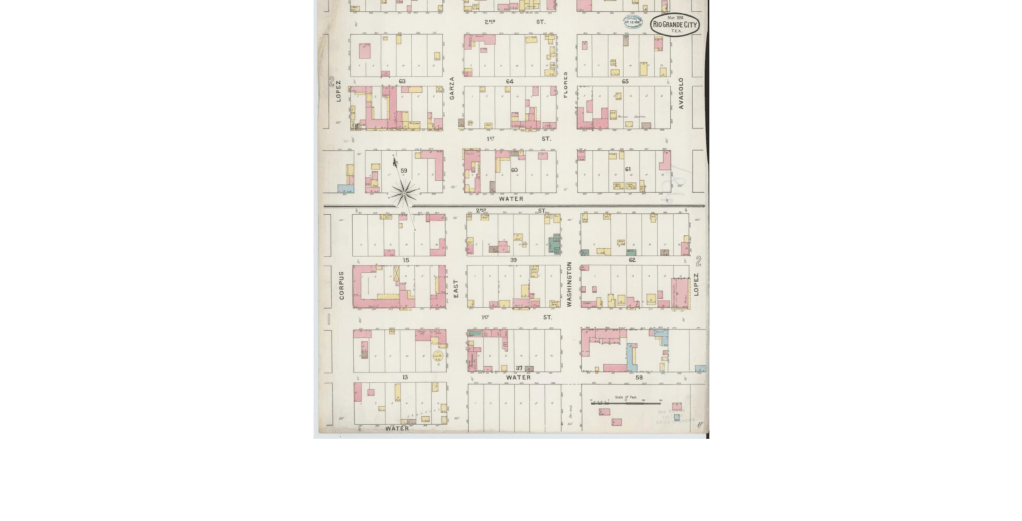
Sanborn Fire Insurance Map from Rio Grande City, Starr County, Texas. May 1894.
I’ve walked these streets before, decades ago. We’d drive the six hundred miles south for Christmas, for funerals, for two weeks every summer while Dad served his time in Army Reserves. What I remember of the streets isn’t much — the panaderia with the best cochinitos, the two story building pockmarked by time where Papa Romulo ran his tailor shop & his cantina, the shops we never entered, the shops that used to be. With every walk down those dusty hot sidewalks, I wanted to get back to the house of my mother’s childhood, back to the pomegranate tree & the screen door with the bell, back to our BB gun and the mesquite trees with their undulating thick branches shading the packed dirt. I haven’t been down those Rio Grande streets in decades.
As I’ve said elsewhere, there’s little there for me now but dusty graves & deep memories. My mother’s childhood home, the only home I knew there, has bougainvillea where the salt cedar once soared, tin foil on the front windows. My brother Raul has the aluminum lawn chairs from the back yard, chairs sunbaked over time from candy-apple red to rust. The display cabinets from Mama Tulitas’s store are in my parents’ garage, once stocked with fresh bread, now packed with gardening equipment & hundred-year-old hat blocks. Not everything is lost.
Recently, I zoomed in on these Rio Grande City streets — or to be more precise, on an alley where my great grandfather Papa Pedro worked as a blacksmith. Click by click, I walked those streets, found that alley, advancing by digital leaps, the camera of all things on a tab nestled between a recipe for Dijonnaise grilled chicken breasts & student submissions waiting to be graded, the camera lens advancing fifty feet at a time in pixelated bursts, landing on sharp focus high-def ground. Getting closer & closer to the terrain if not the hour of this time of hard labor, of honest labor, of manhood, of Mexicanness I never knew. A daydreamer at heart, I don’t need much to conjure up a living laughing version of the strong, serious, mustached man in the photo (one of two we have of him). The digital search / journey awakened nothing my mother hadn’t already shared decades before with the five of us kids walking through the Valley heat, interrupted by her childhood friends running errands. We rolled our eyes. They ignored our boredom, relishing the blessing, the surprise, the luxury platicando. A pin was always in a map somewhere. Now I had seen it.
I went looking for it again in the Library of Congress and found a Sanborn Fire Insurance map of Rio Grande City from May 1894 (one of two the LOC hosts). Even back then, the town had a meticulous geometric order. Sanborn marks the equidistant east-west water lines running beneath a land where water means citizenship, where water means life, where water is a commodity almost as valuable to find as natural gas. Each lot in nearly equal proportions with its neighbors, each street in rectilinear dignity with / apart from the others. From this gods-eye view, Sanborn commemorates each owner shaping the stuff of creation, innovating & compromising within the perimeter of their respective lots, making this little postage stamp of a world their own.
Some homes built as far from the “traffic” as possible. Some buildings (businesses, clearly) constructed as close to the street as safety & city codes will allow. Sanborn color-coded the maps, a different color for each material. Tile. Stone. Wood frame. Brick. Sanborn Fire Insurance imagined a plan for one particular kind of disaster, the kind of disaster that struck one mile west of where the blacksmith shop once stood, that struck my mother’s childhood home on Fairgrounds Road at the Rio Grande City home I knew, that struck July 2, 1981, my twelfth birthday. I had spent that night fifteen miles away at my paternal grandparents’ house in Roma. My great grandfather was long dead. I don’t know where the water lines were in 1981, but I see now where they were in 1894. The time of Sanborn’s map was a time of caution, of preparedness, a time of knives & saws, of clothes lines & woodstoves, of hand carved existences.
My great grandfather had strong rough hands moving quickly in the heat, moving briskly from fire to anvil. He bent iron. It was right there, just outside the frame of the map.
For most of human history, if you wanted to make a point, you had to push. A stylus into clay. A chisel into stone. In certain cases, you could be more delicate. A brush onto a canvas. A quill onto parchment. Horsehair & feathers—something must be shorn, something must be lost, for something to be remembered. The meaning is made by hand. A sometimes slow, near-permanent process of setting & resetting, replenishing & depleting the ink, stroke by stroke. Until 1795.
A scientist serving under Napoleon invented the pencil during perhaps the bloodiest of years in the bloody French Revolution. It was complicated—well, maybe for a scientist it wasn’t. Graphite is one of the softest solids. Mix graphite with water & clay, heat the compound in a kiln to 1900 degrees, and you can shape it however you like. Or, in the case of the scientist Nicholas-Jacques Conte, you shape it so that it slides just so into a kind of wood sheath. Your hand stays clean, your pocket stays clean, and ideally, you can write to your heart’s desire, can write as long as the graphite holds.
Oh, and it’s graphite, not lead. They mistook it for lead when they found huge deposits of the stuff in Bavaria in the 1400s. Huge deposits of a kind of pure carbon. Beneath fields, beneath farms, tucked into hills & caves, humble walls & surprising depths, mounds & chunks of rough dark fragile stuff.
This stuff (soon to be called graphite) was wholly unlike the earth itself, the earth which took on the qualities of the seasons & the elements—earth could become mud, could become soil, could become dust. You depended on the earth’s variety. You could even come to appreciate its smell, knowing that the scent of the earth hinted at what emerged from the womb of its wet darkness year after year. Not this. This medieval discovery of dull gray deposits wasn’t quite dross, wasn’t quite precious, wasn’t lead.
You couldn’t build on it, you couldn’t plant in it, you couldn’t eat it, you couldn’t yet sell it. You couldn’t help but notice how persistent it was, how it filled in the lifelines & love lines in the palms of your hands, how it worked its way into the finest of swirls at the tips of your fingers, how it wrote so much on you without ever seeming to diminish in itself. (If you could keep it from breaking in your hands.)
Maybe they discovered by accident that this pure carbon could mark things easily, like chalk. Wrapping this graphite with string, humble shepherds began marking their flock. Imagine a single shepherd arising from under a tree, the grazing hours of his slow woolly charge over. Imagine him counting nine ten eleven and again with wide eyed urgency NINE TEN ELEVEN, counting & shouting, counting & shoving the sheep still to recount until he confirms one sheep missing. Imagine him leaving the rest behind, at the mercy of the elements, at the mercy of the wolves, leaving the rest behind to go quickly into the open country, seeking the lost sheep. And when he finds his sheep, sees his mark on its wool, he sighs, thanks the heavens, gathers him onto his shoulders, gently chiding the lost sheep with each joyful step back to the flock. We all know where we belong. We all know that such a line can bring order, can shape the stuff of creation. (All lines can.)
Lines on wood, lines on rock, lines on the ground. Not to decorate but to demarcate. To separate this from that. (A kind of godly labor—the god of Genesis creates largely by means of separations & distinctions: night from day, light from dark, the sea from the land, one fruit-bearing tree from the rest of the garden. A divine story written only once.)
Kids must have played with it. Centuries ago, children barefoot, dressed in rough tunics their mothers made, a thin rope for a belt, soft hide for shoes. Centuries ago, when the wild was closer to home, when it was maybe just a stone’s throw from threshold. Kids would go into the hills, knelt at the edges of mysterious blackness, an older kid dragging his hands along it & holding them up to his little sister, hands stained through & through. They rubbed it on each other’s faces for fun, or maybe they grabbed a pinecone-sized chunk of it to throw against a tree, to smash against some of the flat stones that served as staircases up the hill. They got scolded when they got home for sullying their clothes (or they didn’t because to live in the 1400s was to be filthy most of the time). Children for centuries, and centuries.
Until eventually other kids altogether less free rubbed sleep from their eyes while they packed pencils in zippered school supply bags. Pencils & sharpies, scissors & protractors, highlighters & post-it notes. A tool kit for a developing mind, all tools tucked into the same backpack with their crustless sandwiches & sliced fruit. And one tool that Nicholas-Jacques Conte hadn’t considered in his original pencil. These school children’s pencils are balanced—a blade-sharpened black point and a soft tongue-pink eraser.
For sixty years, pencils were practical & variable. Different densities, different sizes, different shapes, most with some sort of flat side so that they would not roll off a surface when set down. Decades of rough drafting. But the stakes were still high—the tracks of the pencil’s journey, the record of the marriage between mind & hand was near-permanent. Sometimes, some pencillers used bread to massage their lines into oblivion, like a magician stroking a bright coin against their flat palm before the yearned-for disappearance. Perhaps with a damp cloth, you could perform a similar magic, smudging away the hasty word choice, wiping clean the erroneous sum, removing altogether the evidence of a human mind erring & backtracking, resounding the mental depths & pivoting toward the true, the right. A pencil’s work held fast. Until 1858.
A stroke of not-original not-genius: A writing point on one end, and on the other end, the polar opposite. A piece of rubber that would also be sharpened, depending on the error to remove. Hymen Lipman wrote / wrought a tool of & for human ingenuity at its messiest, a tool of re-vision most deliberate, the very tool we know today. In an ironic turn of historical events, Lipman had his patent erased by the Supreme Court, the great righter of wrongs, the great writer of rights & wrongs. Lipman had no legal claim to a patent, having merely merged two inventions; Lipman created nothing so that we could create anything.
So we do.
Following the dotted lines that guide us letter by letter into shapes of meaning, words we’ve only heard. And a few years later, connecting dot 3 to dot 4, bringing shape to the empty quadrant of the kids’ meals menu. And a few years later, showing your work—substitution & misstep, reduction & inversion—narrowing line by line till the barest most declarative of meanings, X equals, the end to the erratic path from chaos to value. Later still, entering testing rooms, sitting for hours with everyone across the country your age, a bored adult at the front, while we bubble in our futures, recognizing that there is often no correct answer but merely the best possible answer. Until things really matter.
And you reach for a pen.
*
*
*
[shavings, that is, pieces that never got sharpened or that didn’t fit in the sharpened draft]
Pencil shavings. Pencil apron—the part that’s the wood part that your index finger rests on. It’s called the “apron” of the pencil. I didn’t know it needed a name
The point of no return—we really use only half a pencil’s full resources before we throw it away. A pencil, though, If you’re careful, a pencil lead can last 731 miles.
St Luke’s Catholic School—they had NFL themed pencils at the store. They wouldn’t let you choose your team. You’d give the lady the money, and she made a big f7cking deal about reaching into the box without looking so that nobody could accuse her of letting you actually choose the pencil you wanted. One time I gave her my money, and she locked her eyes on mine, reached into the box & handed me a Tampa Bay Buccaneers pencil. In the mid-70s, Tampa Bay had the worst team colors in the entire NFL, and I was so pissed off, and Jimmy D came up behind me and laughed about it. Jimmy was a rich only child asshole whose mom had bought him a whole dang box of Dallas Cowboys pencils, whose mom one time asked my mom to have me come spend the night at his house, and I didn’t want to, but my mom told his mom I would, so I did, and at the end of this annoying afternoon & evening trying to have fun with this kid in his huge house with loads of toys & things, we move over to his bedroom to go to sleep, and I see that he had this huge room all to himself with a bed all to himself, and I’m coming from a house where I share a room & a bed with my brother, and Jimmy’s bed has satin sheets like a girl, and I was so confused because he was such a loudmouth bully, such a little prick, but he had these satin sheets all paisley patterned in royal purple and forest green, and I thought This jerk oh my G-d, and I just couldn’t wait to go to school the next Monday to tell everybody that he slept on satin sheets, but as I got into the bed I couldn’t figure out why this whole thing was weird, and I worried that maybe I alone would think it was weird, and I figured on second thought maybe I didn’t want people to know that I spent the night there because we weren’t really friends, and I realized that my mom pitied him, that my mom knew he was a little prick, and I’m there in this big satin bed with Jimmy, realizing that his mom must have known he was a prick with no friends, which was why she reached out to my mom because I was known as a nice smart boy (I was a nice, smart boy), so I fell asleep, having prayed to myself & having decided that I wouldn’t tell anybody about his sheets, and now here he was laughing at me, and I wanted to shove the pencil into his ear, so I imagined doing it & him crying & bleeding. That all happened. It happened just like that.
Pencils tucked behind ears, one of the most natural resting places for a thing unnatural
Version 1 of the paragraph beginning “Kids must have”: [version 1] Maybe kids played with it. Centuries ago, children barefoot, dressed in rough tunics their mothers made, a thin rope for a belt, soft leather shoes. Centuries ago, when the wild was closer to home, when it was maybe just a stone’s throw from threshold. Maybe kids went into the hills, knelt at the edges of mysterious blackness, an older kid dragging his hands along it & holding them up to his little sister, hands stained through & through. Maybe they rubbed it on each other’s faces for fun, maybe they grabbed a pinecone-sized chunk of it to throw against a tree, to smash against some of the flat stones that served as staircases up the hill. Maybe they got scolded when they got home for sullying their clothes, or maybe they didn’t because to live in the 1400s was to be filthy most of the time. Maybe.
Standard yellow pencils. The hexagonal design — what other things come in groups or sides of six?
Her hair is lathered & twisted into the unicorn peak she likes.

I lean over, and she slaps the bathwater, giggling at my dripping face.
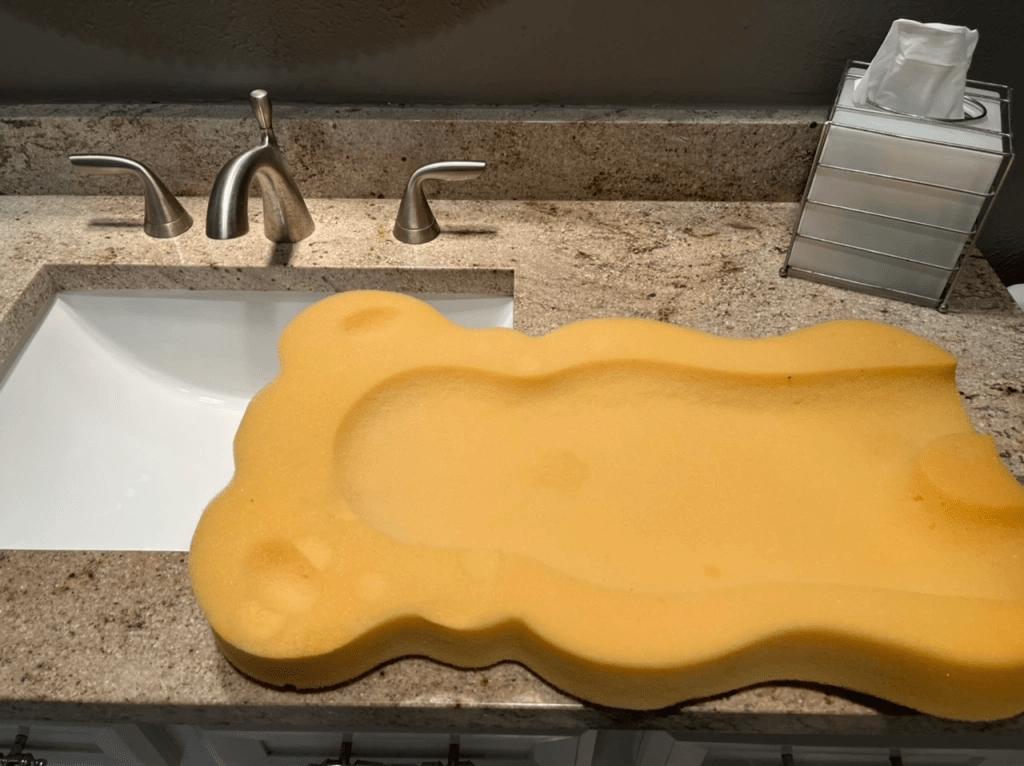
I mock-scowl and reach for the bright red bowl buoyed in the undulating foam.

We test the water from the tap before she leans her head back, her throat all a-glimmer,
her tiny shoulders perfectly round—I shield her eyes with one hand, pour with the other.
Later, a spiral of water at her feet, the clean girl floats, arms outstretched, embracing it all.
And in the end, things happened quickly.
After years of protracted silences
& painstakingly unmended fences,
we both woke to an email finalizing
the divorce.

Neither of us knew that this would be
the wished-for day. She woke in our house,
I in my shabby place, grousing
internally about the other, replaying
old arguments.

And now there was nothing left
to divide, nothing to fight over.
Fees prepaid. A finally-shut door
kept us safe & far far from one
another.

On opposite sides of town,
the baristas told us,
"Have a nice day."

"You too."
"You too."

This was written for a National Poetry Month challenge, an April Fool's Day poem, something untrue. Sometimes when I write about me & my wife, I use that image, William H. Johnson, Café (ca. 1939-1940) but not always.





 middleagedmiddlechild.
