May your feet be warm & dry
May you hear your name said with a smile today
May your nights be peaceful
May your work be meaningful
May someone you love think that you are smart & funny

May your coffee be served just right
May you see your child laughing
May you enjoy the book you're reading -- and the next one
May you feel the warmth of the setting sun

May your children be safe & happy
May they grow up to love & talk to one another
May they have dogs & beloveds that love dogs
May the clouds always inspire you

This is inspired by a three-part writing challenge that Sarah Freligh gave my students--write blessings for all people everywhere, then blessings for someone difficult to love, then for yourself. The image is by my friend Scott Lewis, from his series God & Globalization.
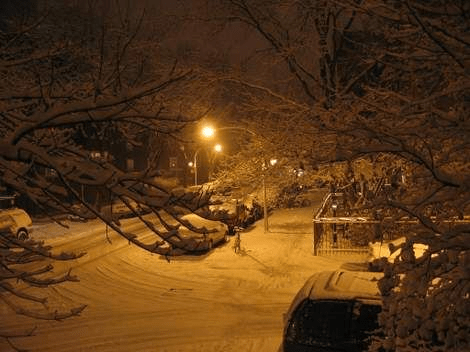
The wind was blowing most of my first day in town, and the snow flakes fell gently, slowly, cartwheeling to me with cartoonish clarity, like a confetti’d welcome for us alone. We were two blocks from a good bar, a decent diner, a video store, and an El stop. We were in love.
She had chosen our home well–not the hippest neighborhood but still one that felt like a city I’d never known, like a place where the rest of my [ahem] … where the rest of our life together would begin.
Instead it was an extended break, not quite vacation not quite holding pattern. I continued teaching but not well. She found a job at company called Oracle. My wife looked her up. (I was curious too.) Apparently, she still works there. She set down roots; I did too, somewhere else.
The wind blows there even now as strong as ever. I saw it on TV the other day. It looks just the same as it did that January.
The image is from Andrew Sullivan’s View From Your Window feature. I saved it as “ChicagoIL930pm” but cannot find the original source or photographer.
You create an account gently, and you construct
a password--a nonsense mixture made memorable,
letters, numbers, characters made special
somehow, a song lyric, a sentence you alone know.

You pull the doc from the drive, a last look
at a once-inspired miracle, a polished
inert version of the original spark, now rendered
regular, out of your hand & into gently.

Gently receives the doc, a new screen
assuring you that the server worked.

You forget and wait, gently. Gently managing
the impersonal viewable shareable
version of you at your most artful,
most vulnerable, most hopeful.

Three weeks later, gently a message
in your inbox.

No.
Thank you.
Sincerely,
Gently.

This is inspired by Sophia Terazawa, who gave my class the following writing prompt: Personify an adverb. I chose to personify the writing submission platform Submittable as the adverb "Gently". So above every time I originally referred to the platform, I substituted the word Gently.
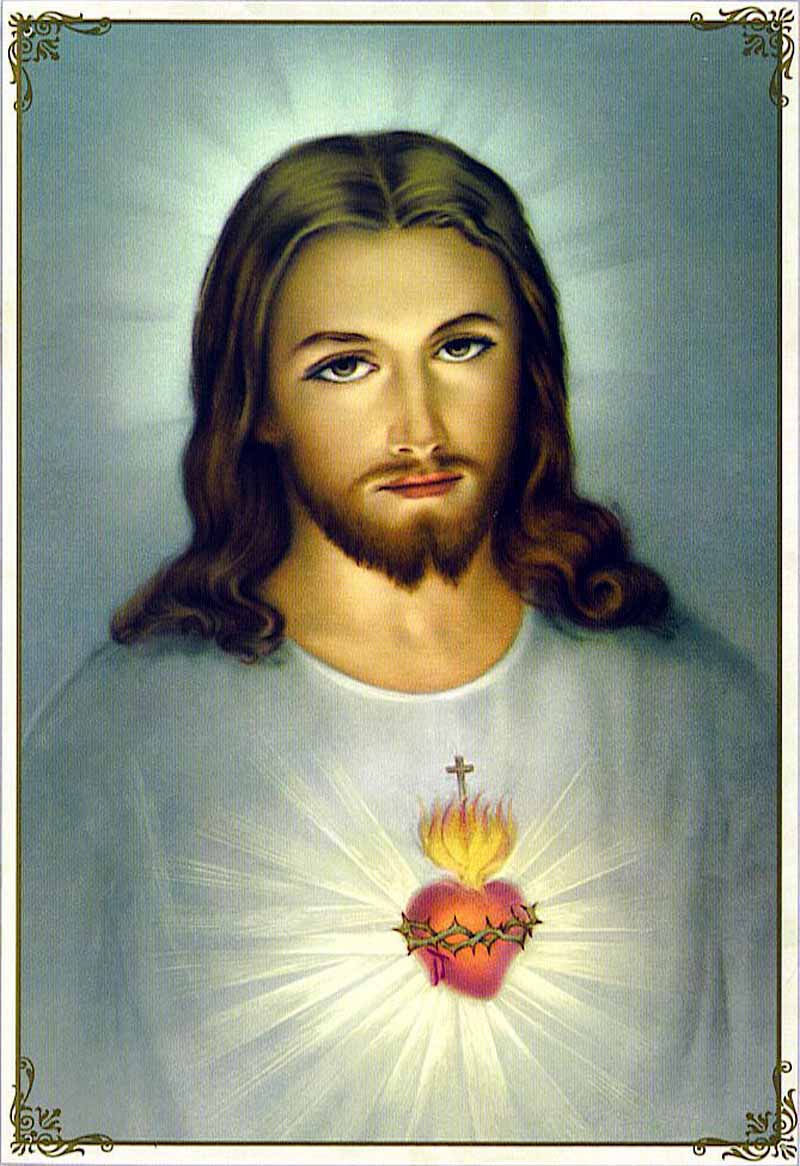
An image I grew up with, in my home, on funeral cards, at school, everywhere.
I read somewhere that G-d is merciful,
watching, judging, understanding, but still

merciful. The quality of mercy, I read
somewhere else, is not strained. It droppeth like ...

well, it's freely flowing. It isn't meted out
like some precious resource (though it is).

It is worth much more than it costs to give.
There is always a person to forgive

and a reason to forgive, if for no other reason
than that it gives you practice

in feeling how little it takes to bless
a person in error, in distress, deep in shame.

Even when we know that they'll just mess up
again, in our mercy, we bring a part of heaven

to earth.

"kyrie eleison" means "Lord, have mercy." This was my last sprint write with my students on May 18, 2022, modeled after Clint Smith's "Meteor Shower".
An orange shirt hangs in my closet. My second ever.
It's got a sheen & a stretch altogether unnatural,
some space-age material that doesn't breathe & doesn't fade.

It's a golf shirt from another era, a stiff broad collar,
more buttons than are necessary, and a deep breast pocket.
There's a duck on the pocket, also from another era.

Summer 1988, north Austin, I'm watching my girlfriend shop
in a fabric store. We were young enough & in love enough
to do everything together then, even things I didn't want to do.

I rotated one of those product kiosks, bored & annoyed.
And there the duck was on a tiny card, a bright silly thing
that I knew would make her smile. She sewed it right on

an orange t-shirt I wore probably once a week. Decades after
we broke up, the shirt lost its snap, and I lost my taste for it.
I threw away the shirt but kept the duck. I showed it to my wife,

who sewed it right on a new orange shirt. My second ever.
Here in the closet, in the home we share, a bright sign of
how to adorn a simple thing, of how to keep love near your heart.
Inspired by the love of two women and by this poem.
You wear a white shirt,
grey slacks, and a plaid tie.
A uniform of academic
seriousness & middle class.

You roll your sleeves up
& unbutton your shirt
at the neck. You feel there's little
on the surface you choose.

You are freest on your paper route,
especially Sunday mornings
weaving slowly from curb to curb,
crossing the double yellow line.

All four lanes yours.
The city asleep.

Inspired by Erika L. Sánchez's "The Poet at Fifteen", which was inspired by Larry Levis's "The Poet at Seventeen".
There is a tree at the heart
of our house. A live oak
reaching up in three directions,
waist-thick master branches
rough & mossy.
I imagined it as mine
the moment I saw it.
The house would belong to all.
The tree to me.

From beneath it, I can see
into each room. I don't look up
often enough. I look around,
from window to window,
at my family, my house
alive & secure. A life-size diorama
I'm growing old in.

Every few years the tree gets trimmed,
sometimes as much as a third of it
gets sawn off, mulched, & driven away.
The dust settles bright & aromatic,
a sandy pattern within
the ridges of the roots.
The canopy lifted,
the shade dappled anew.

And my tree bounces back,
quickly dense again with leaves,
stretching up imperceptibly,
inch by delicate inch over
the chimney, over me.
I sit, book & wine at hand.
Breathing deep & waiting
to be called back inside,
back home.
Three Chimneys parking lot, Greenhill School, April 27,2022
Every few summers
right before the kids return,
the cones & ropes come out
directing traffic somewhere else.

There's a potbellied trailer
spattered & smoking, surrounded
by men in fluorescent vests
& tarred steel toed boots.

The asphalt goes down
thick & clean, the oily heat
rainbowing & distorting
the new view.

Then a slower process,
stencils & block letters,
striping & labeling:
students & faculty,

visitors & diagonally reserved spots
we hope never to need,
a reminder of the everyday horrors
that happen somewhere else.
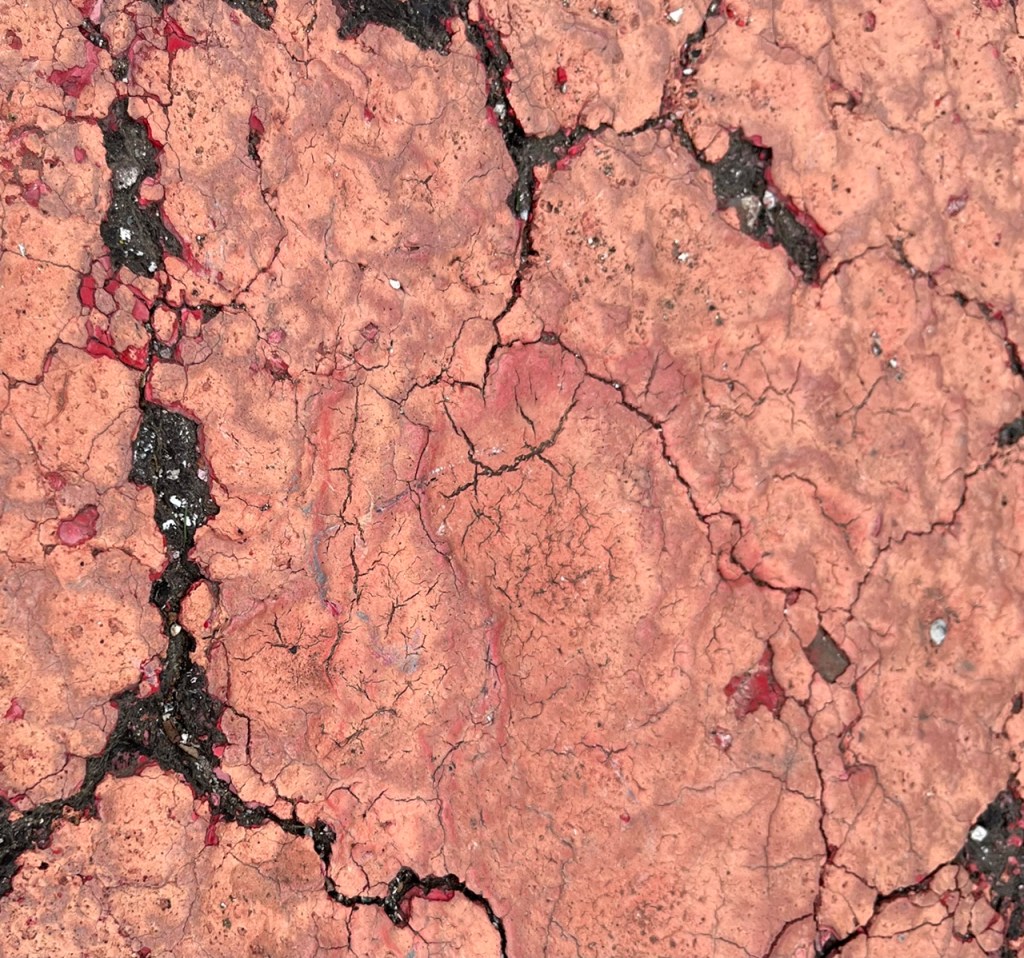
Years later the colors return
to the earth, as we all must.
Cracked & bubbled, a broad mottled stripe
thrown into relief by sun & time.

The lines, faded & crumbling,
can still keep us safe.
We remember
where we belong.
On April 27, I sent my students outside with their phones to return with photos of different colors. This is inspired by a color I found.
Along with the usual noises
(washing machines, wind chimes),
this house has other voices.
Scratches, creaks, murmurs, all times,
all corners of the house. Like a
conductor tapping a baton,
a critter's feet ticks out a
path across the roof, lighting upon
the shingles faintly. Beneath
the deck, deep in the shrubs,
a bit of digital-ish noise beeps
& chirps, then drops out, an abrupt
small wild world alive, persistent -- but each
time I approach, silent, just out of reach.
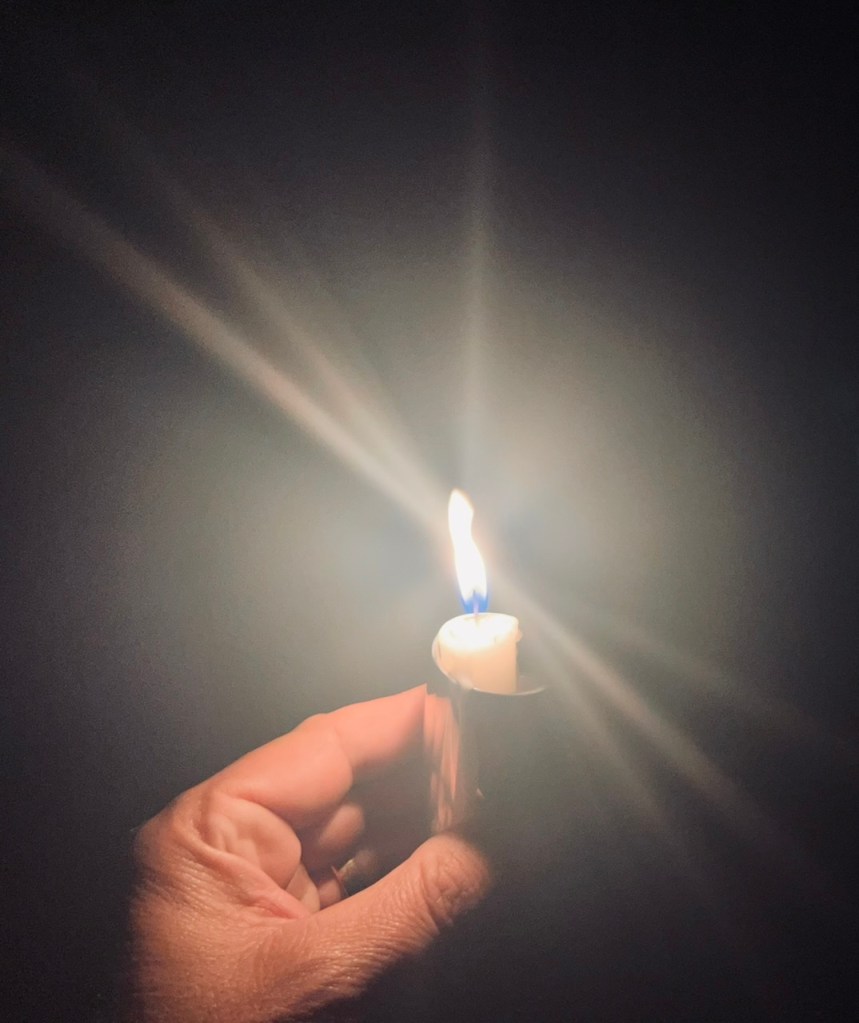
which is to say
in the darkest of hours
there's a flickering,
an easily snuffed light.

You can lift it,
you can move it,
but you must
protect it.

A hope chest holds
soft elegance,
handstitched care
for the body & the bed.

A hope candle can last
if you're careful & still.
Keep it close.
Keep it dry.

Watch hope dance then stand
to reveal dangers, to ennoble
wide eyes. Windowed, mirrored,
it even grows.

Hope throws big shadows,
darkening what's behind.
So look ahead, look close.
And hold your breath.