Skip to content

middleagedmiddlechild.

I write.

I read.

  • i read: january 2024.

    January 6th, 2024

    The summer of long books (The Name of the Rose, The Illuminaries, etc.) gave way to the fall of reading cool stuff and things that finally came up in my Libby queue. I’m glad that I’m getting back into the habit of tracking my reading, though.

    Jennifer Egan’s Manhattan Beach had been on half-price shelves frequently enough that I worried it was one of those novels that people purchased but didn’t finish. I finished it, quickly.

    Within the opening pages, I was reminded of a novel that I really enjoyed–city setting, poor Irish family, young girl, etc. Those characteristics lingered through Manhattan Beach even as the setting shifted to the sea, even as the family’s fortunes improved, even after the young girl became a young woman. Anna Kendrick pays a visit with her father to the luxurious shoreside house of a handsome charismatic man that, like her father, thrives in the liminal space between polite society and gangster society. It’s an affecting opening, one that shows the deep pull that each man has on Anna and the deep pull that the sea has on her.

    Egan moves Anna’s affections & fortunes briskly back & forth between these men, between these settings, between then (near the end of the Depression) and now (near the end of WWII). The set pieces, such as a trip to a Times Square jazz club, always feel authentic; the historical research, such as the fine details of military deep-sea diving, always feel essential to the internal life of the characters.

    The secrets & desires of the main three characters are at the heart of the novel, and the secondary characters (an aunt that was a silent movie bit player, a mysterious man-behind-the-men mafioso) keep you alert to the ways that a character’s fate is in the hands of so many. It was, in short, a fully human, fully historical, fully suspenseful & satisfying novel.

    Like many folk around the pandemic, I’ve read my fair share of minimalist books, and I’ve watched a lot of YouTube reflections on the practices & payoffs of severing yourself from things. It’s not easy for me. A huge part of my identity was formed around the content I consumed & curated, shared & gave. Music, books, movies, and now podcasts, were the main elements of my intellectual self–and of my material self. What is left when I sever ties or when I throw away these things? Abraham Joshua Heschel has an answer.

    In The Sabbath (1951), Heschel offers a powerful argument for re-viewing this severing not as a loss but as a chance to rejuvenate. Each chapter is both scripturally rigorous and personally considerate. It’s a book that hits you in the heart & in the head, that offers wide gateways into thinking about opening up what the sabbath provides, in Heschel’s words, “the architecture of time”. The week doesn’t end with the sabbath; it culminates in the sabbath. Everything we do during the week is informed by, is nourished by, is made sacred in this much-needed, oft-misused time.

    The Sabbath is not a lengthy book, but it’s one that I needed to read quite slowly, so poetic & elegant is the prose. It’s not a stuffy orthodox book, but it’s one that shows the vitality & gift of a cultural, spiritual inheritance. Representative quotation: “[…] the sabbath is not an occasion for diversion or frivolity […], but an opportunity to mend our tattered lives, to collect rather than to dissipate time. Labor without dignity is the cause of misery; rest without spirit, the cause of depravity” (17-18). Heschel offers the reader gems / challenges like that three or four times a page. It’s a dizzying & challenging work, one that guides the reader to interrogate their own values, their own choices, and the consequences of living so busily that we don’t let menuha (tranquility, serenity, peace and repose) in.

    Álvaro Enrigue has written two novels that play with history. The first, Sudden Death, dazzled & delighted me with its deft bouncing between Old World & New World, between painting & poetry, between high art & low urges. In it, the tennis court becomes a central setting at a time when tennis was a game of rogues & royalty, a blood sport more akin to Fight Club than to the crisp uniforms & silent well-born audiences of today’s tennis courts. In its brutality & humor (& in its deliberate veering from / inspiration from the personages of Caravaggio & Quevedo), Sudden Death reminds the reader that the writing of history is, at its best, a righting of history–and not always what we would call an accurate one.

    You Dreamed of Empires is equally profane & thoughtful, equally of Europe & Mexico (or more accurately, of what would become Mexico). Sudden Death‘s tennis games are replaced by …. well it depends on the word you’re most comfortable with. Diplomacy or ritual, conquest or evolution, dreams or naps, wills or visions, the ancient clean or the modern grit. Enrigue calls this novel an account of the birth of the modern world–November 9, 1519, the day that Cortes meets Moctezuma, or the day that Moctezuma hosts Coretes, or the day that Moctezuma fits Cortes into his schedule while he’s trying to manage the dissolution of a multi-tribe/nation/people alliance, or the day that Moctezuma gives Cortes hallucinogens to trip together.

    Enrigue delights in anachronism (T.Rex Monolith playing in the background of a Tenochtitlan temple) and outright fantasy (Moctezuma dreaming the author himself centuries later writing the account of Moctezuma dreaming the author himself …). He delights in what Toni Morrison called Homeric fairness, where no monster is without his humanity, where no slave is without power, where Spaniards & indigenous people can’t stand the smell of one another and can’t shake the allure of one another. It’s a quietly feminist novel, one in which Cortes is referred to as El Malinche more often (I think) than Malintzin is referred to as La Malinche. And it’s got a heckuva ending.

    If I’ve read Philip Roth before, I can’t remember — which is saying something, just having finished Operation Shylock: A Confession. The voice is a difficult one to forget. Utterly personal in tone, brashly direct in how it interrogates Jewishness, how it describes the / his male libido, how it invites you to laugh at serious things & take mockery seriously. The subtitle here should have been a greater key to the book than it was.

    Not a novel–not something made up. Roth not only depicts himself as he is (late middle-aged, lauded but not Nobel’d, keenly aware of his weaknesses & talents, a diasporic Jew) but also constructs depicts a double Philip Roth who looks like PR, who knows PR’s entire personal & professional history, and who is busy with his own non-fiction, high-stakes world-building: soliciting help from well-known illuminaries such as Lech Walesa & the Pope as well as quietly influential figures working in & on behalf of the Mossad to get Jews out of Jerusalem, where the double-PR says they’ve never belonged, and back to Europe, which the double-PR says is much more their natural home.

    The confession is not Roth’s alone. Roth recounts the confession of a former grad school acquaintance (in this case, an Egyptian professor) consumed with righteous anger over what Israel has done in Palestine, has done to Palestinians. He recounts the confession of a former anti-Semite, the former-nurse of the double-PR, who creates a kind of AA for recovering anti-Semites (the “real” Roth line edits his twelve steps). Roth observes a Jerusalem courtroom (show)trial, hoping to hear the confession of John Demjanjuk, a defendant denying that he is Ivan the Terrible.

    There are briefcases full of money. There are mysterious phone calls. There is an apologia to a different strand of anti-semitism probably ever chapter. There are masked would-be kidnappers prowling under cover of the night. There is pathos & stupidity. There is a kind of Hebrew school lesson / subtle Mossad interrogation / protection scene. There’s a chunk about halfway through that summarizes & clarifies just how weird these true events you’ve read are. There is a Preface, explaining the still-ongoing legal facts of “the confession”; there is a closing note to the reader asserting, “This confession is false.”

    I’m not making it sound funny enough. Or serious enough. Or timeless enough. Or timely enough. It was / is all those things, true or false.


  • detour.

    January 5th, 2024
    Justine Kurland “Star Children” (2000)
    We were in the car together
    one lazy Sunday afternoon,
    driving through a rich neighborhood,
    heading toward our favorite creek.

    Years later, we returned
    to that creek, a ring
    in my pocket.
    She said yes.

    This afternoon years earlier
    she told me to pull over.
    A girl alone had lost
    her balloon in a tree,

    a red balloon that
    my beautiful girlfriend
    pulled delicately
    from the branches.
  • alumni.

    December 30th, 2023

    Many students will never write for fun again, will never choose to read a poem again, will never [sigh] read a book if they don’t have to. This time, this concentrated time, this shared & free thinking is all too often fleeting. They’re eager–most of them–to leave by the end of it all, they’re eager–many of them–to leave it all behind. They know what they’ll be leaving behind, and they won’t much care.

    And I will not care that they won’t much care because I know that this carelessness too is fleeting. Rooted in even the most careless, when they think of it at all, is some respect for my respect for our work, for our words together. And at some future reception, they’ll tell me, unprompted, “You know, I still have that book”.

    A book they’ve held over & over again, that they’ve packed up & moved, that they’ve unboxed & put on a shelf, that they’ve preserved for years, maybe that they’ll hold & carry, store & stare at (even if unopened) for their entire lives.

    To them a symbol, to me a record, of their once-deep thinking, their once- and maybe still-widened mind.

    Inspired by my discovery somehow of this word–se·​rot·​i·​nous sə-ˈrät-nəs : remaining closed on the tree with seed dissemination delayed or occurring gradually

  • on foot.

    December 14th, 2023
    Image source
    You celebrate the first steps
    which look like what they are,
    a controlled fall. Eyes wide
    in joy, in disbelief.

    The steps grow varied
    in pace in path in purpose.
    You're often alone, doing your best
    to keep moving somewhere somehow.

    Eventually you walk without thinking,
    your horizons & paths narrowed--
    appointments not destinations.
    In rare moments, your eyes open,
    your feet fly, knowing nothing
    can hurt you till you stand still.

  • theater kids.

    December 6th, 2023
    Backstage, Rose Hall, Greenhill School.

    The doors are heavy, falling shut with a slow ease & finality. The space is sacred to some, to those who work it, to those who hope to cast the spell.

    Every theater has its own relic’d beauty–loose hinges on the front & center seats, faded fluorescent tape marking the limits of characters long silent, scarred lines marking the props dragged season after season.

    The heights are seen only by the lucky. Sandbags & catwalks, lights & innumerable cords. Rows of scrims, depths of story, layers of place.

    You get on stage with the rest of this unkempt bunch, untied Converse shoes & loose t-shirts. You shake the tension from your shoulders & join hands, centering yourself in this song & dance, this ceremony seen only by the lucky, performed only by this loving few.

    Let us play.

    Thanks to Ruben Quesada for the guidance during a workshop in July 2022, when I wrote a lot, including this draft, when he challenged us to capture a time of joy.

  • after mark strand lines for winter.

    November 27th, 2023
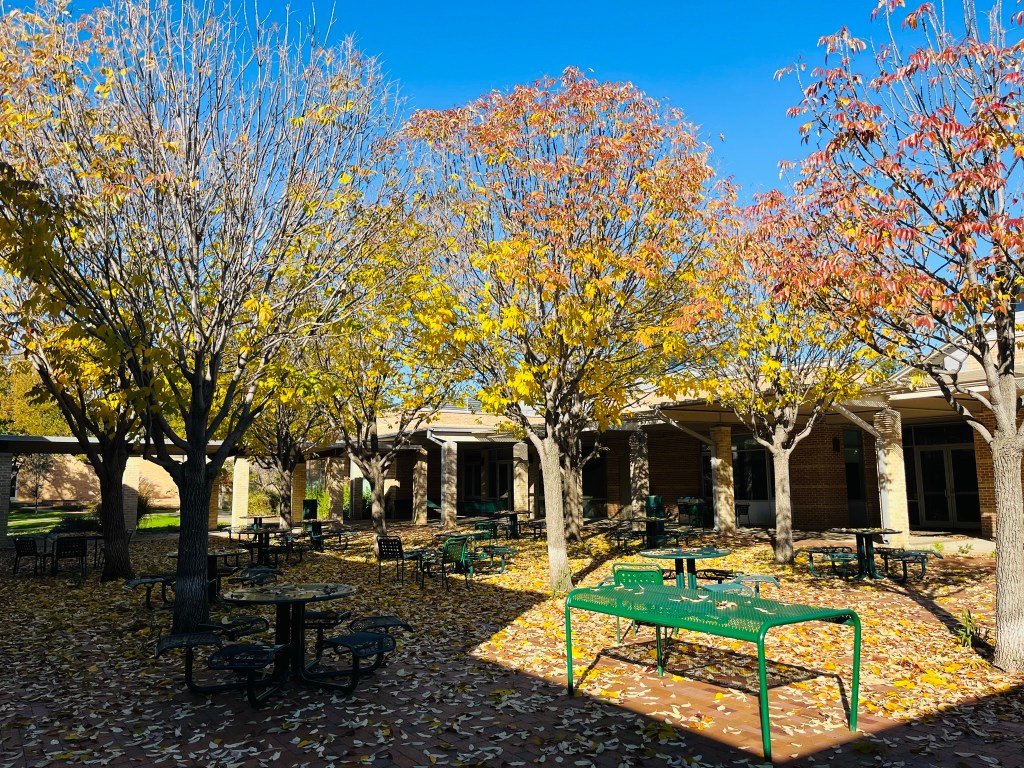
    Courtyard, Greenhill School November 2022
    Tell yourself as it gets cold & gray
    that it is going to pay off. 
    The planning & grading,
    the commenting & designing,
    the paperwork & meetings. For you
    there's the chance to reset over & over.
    New units, new semesters, 
    new years, new courses,
    December punctuated loudly
    with good news from seniors,
    a future they hoped & worked for, 
    acceptance, relief.
    
    Tonight as it gets cold, 
    count the days, and know
    that there is never enough time and
    that there is always just enough time.
    It resolved, or it didn't 
    in ways you'll never know.
    They learned & they struggled
    in ways you'll never know. 
    And you'll start it all again
    sooner than you can imagine.
    
    And if it happens that you cannot
    reconcile yourself to this necessary
    end, this final weeks, then delight
    in the joy of your students, for whom--
    in the best possible ways--
    you were just another adult
    standing in the current of their lives,
    guiding them, and telling them,
    Good morning. Good job. Goodbye. 
  • her tree.

    November 10th, 2023
    She had high hopes for a tree that flowered.
    So many in this neighborhood were planted
    for another place, dense canopies
    you might see in a movie or
    in some part of town
    richer & older.

    She hired an arborist, a kind & fussy man
    who called each tree by its Latin genus name,
    who spoke surprisingly good Spanish
    to his crew scurrying high above,
    chainsaws swinging heavily
    from their loose belts.

    They removed the old tree, its spiky circular spores
    tucked in the grass for years after. She watched
    as they lifted the new tree from the bed of the truck,
    a canvas bag diapering its thin roots.

    They drove spikes into the earth surrounding
    the hole, upturned & fragrant. The roots of the old tree
    were left to wither in the unseen deep.
    She imagined the burst of color to come.

    The tree grew & flowered, less bright
    than she had hoped. A freak cold snap
    historic & long chilled the tree to the core.
    Her husband watched it for weeks,
    certain something could be saved.

    Different men were hired to make rough cuts,
    feeding the fallen branches into a machine
    at the curb, mulching them briskly
    right before their eyes, dust catching
    in the brittle grey grass.

    It grew the next year thick with leaves
    near the trunk. Branches will come anew,
    they thought, will come later.

    It flowered as before. It flowers
    each year, waving gently
    in the piercing Texas sun.

  • רוּחַ

    November 8th, 2023
    Edvard Munch, Fruit Trees in Blossom in the Wind

    “I think everyone should be able to pick a word that moves them, and occupy it” (Eileen Myles, in the afterword to this anthology)

    My word came to me late, in a language I don’t know. I can’t write it, and I do a poor job saying it: רוּחַ. Ruach, that is, spirit, unless it means wind, or unless it means breath, or unless it means something else.

    I’d like to be that רוּחַ heard before it’s felt, almost never seen, energized & untroubled by obstacles. Even those windbreaks I’ve seen (straight, high in their fields) are flat & small in the full force of a vast & powerful רוּחַ.

    I’d like to be that רוּחַ that swells & enlivens each living being. Enriching the blood imperceptively, autonomically, feeding each cell from head to tail, then disappearing, returning seconds later all life long.

    I’d like to be that bold רוּחַ I once was, alive in the spirit. G-d moves within me, I’m certain, though it’s been a while since I occupied the spirit, since I prayed with that presence, since I prayed for that presence, since I prayed. The spirit calls often & in ways unimaginable. Let all who hear it come, let those who are thirsty come drink the רוּחַ like water, drink it without pride.

    This varied earliest holy רוּחַ … the word came to me long after I’d felt it, long after I’d embodied it, long after it had blessed me. The idea, the promise, the gift of רוּחַ has always been here. Bringing natural beauty nearer, filling my chest, nourishing the smallest most intimate parts of me, blessing & keeping me.

  • taste & see.

    November 3rd, 2023
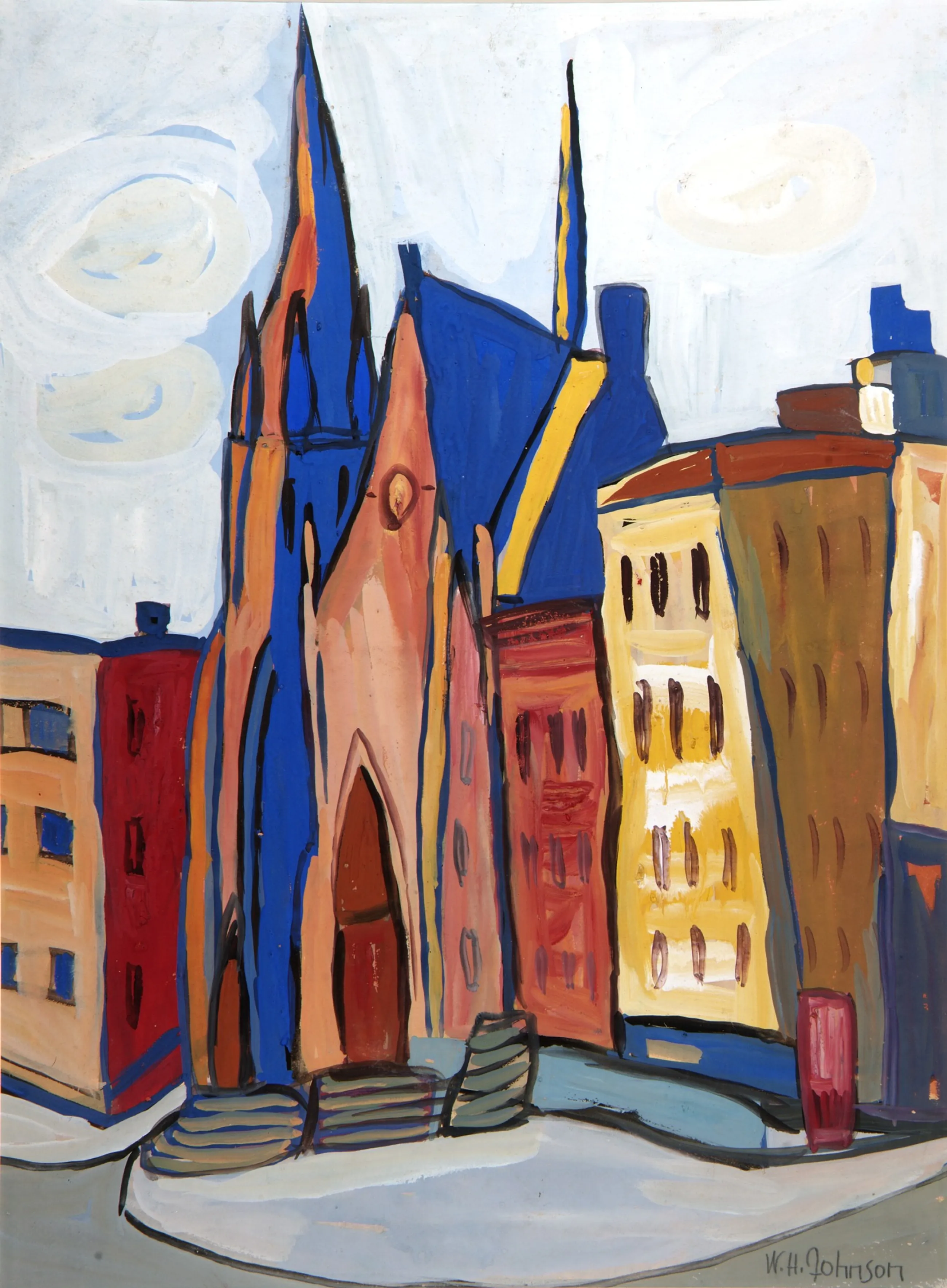
    William H. Johnson, Church on Lenox Avenue (ca. 1939-1940).
    We were lined up by height, walking somberly to the altar, pews filled with proud parents.
    Back then Granny couldn’t afford much, but she got me an Avon Batman brush as a gift.
    I was at home here. Praying, singing, kneeling, and being filled with the spirit. 
    In the photo of our class that day, I am toothless, looking off camera. I know I was happy. 
    
    Back then Granny couldn’t afford much, but she got me an Avon Batman brush as a gift.
    I imagine now the Avon lady coming to her door, Granny sitting by the room unit, looking over the catalogue page by page.
    In the photo of our class that day, I am toothless, looking off camera. I know I was happy.
    Years later, we found out what the priest had done to that community, to those kids. 
    
    I imagine now the Avon lady coming to her door, Granny sitting by the room unit, looking over the catalogue page by page.
    What do you get a child? What do you get this child? What will his parents think? 
    Years later, we found out what the priest had done to that community, to those kids. 
    The parents, horrified in their blind trust. The newspapers laying bare the worst. 
     
    What do you get a child? What do you get this child? What will his parents think?
    The trial stretched out. We knew the name of the priest--the children’s names, only whispered guesses.
    The parents, horrified in their blind trust. The newspapers laying bare the worst. 
    And one lingering memory: A priest doing chin-ups on the blacktop, children beneath him, counting.
    
    The trial stretched out. We knew the name of the priest--the children’s names, only whispered guesses.
    We moved to the church across town. It was the first of several moves my parents made on principle.
    And one lingering memory: A priest doing chin-ups on the blacktop, children beneath him, counting.
    And a memory my mother shared only recently: Shouting at the pastor in the rectory, slamming the door.
    
    We moved to the church across town. It was the first of several moves my parents made on principle.
    An unnecessarily partisan homily here, an unwelcoming community there. Where is the life of the spirit? 
    And a memory my mother shared only recently: Shouting at the pastor in the rectory, slamming the door.
    These cloistered virgins were in over their heads. I almost pity them. I tried to love them. 
    
    An unnecessarily partisan homily here, an unwelcoming community there. Where is the life of the spirit? 
    My parents, hungry for the body of Christ, made a home that seems now like an answered prayer.
    These cloistered virgins were in over their heads. I almost pity them. I tried to love them. 
    What could they know about the faithful? Didn’t they know this passing stop for them was home for us?
    
    My parents, hungry for the body of Christ, made a home that seems now like an answered prayer.
    Where two or three are gathered together in His name, G-d is there. You felt it. You knew it. 
    What could they know about the faithful? Didn’t they know this passing stop for them was home for us?
    Some have married. Some have died. Some moved on. Two that blessed me then are now in prison. 
    
    These days I walk down the aisle rarely. But I still believe. And I pray that I go in peace to love & serve. 
    
    This is my first pantoum ever, a kind of return to this moment. The title is from Psalm 34:8.
    
  • second or third love.

    November 1st, 2023
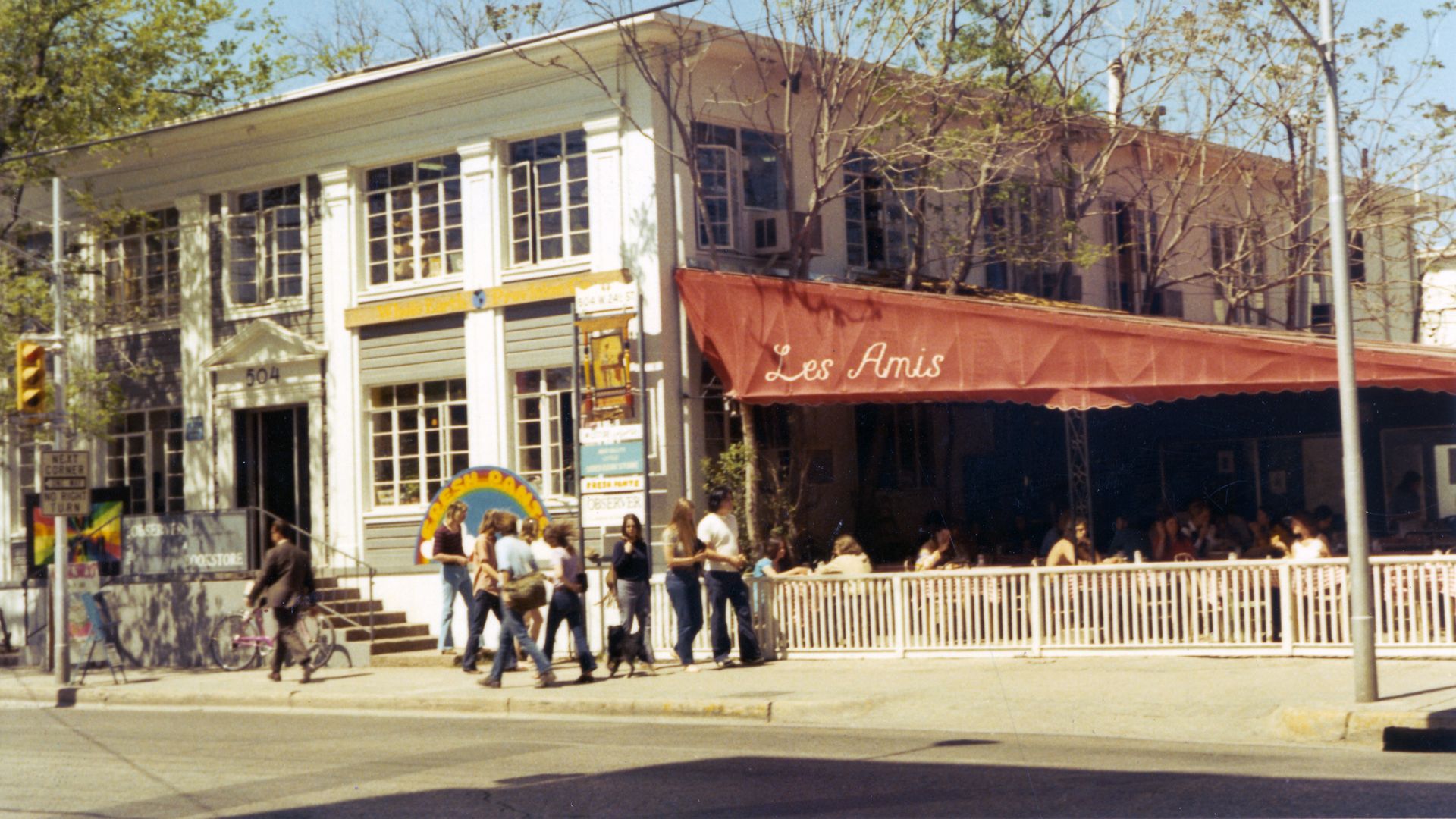
    Image source. That spot now.
    Like many things in fall 1988, this all starts
    in a dark smoky place. A cafe
    near campus.
    
    She has opinions & confidence, long brown hair,
    shockingly bright blue eyes.
    Katie.
    
    We moved to Chicago together years later,
    mining that time in your twenties when everything
    seems possible, nobody's married yet, and all we had
    was time, cigarettes, some money, and each other.


    Another writing exercise limited by one's phone number--each digit provides the number of words allowed per line. I wrote about this same relationship before, at its beginning & at its near-end. 
    
    
←Previous Page
1 … 4 5 6 7 8 … 16
Next Page→

Thanks for reading–and there’s more! Click here for things I write. Click here for things I read.


Loading Comments...
 

    • Subscribe Subscribed
      • middleagedmiddlechild.
      • Join 30 other subscribers
      • Already have a WordPress.com account? Log in now.
      • middleagedmiddlechild.
      • Subscribe Subscribed
      • Sign up
      • Log in
      • Report this content
      • View site in Reader
      • Manage subscriptions
      • Collapse this bar